Blog · Business & Entrepreneurship
Why Do New Businesses Fail? What Survival Data Teaches Founders in 2026
About half of new US businesses are still operating after five years. Government data and the Global Entrepreneurship Monitor show when firms fail, why, and the habits that improve the odds.
By the Editorial Office 6 min read8 sources
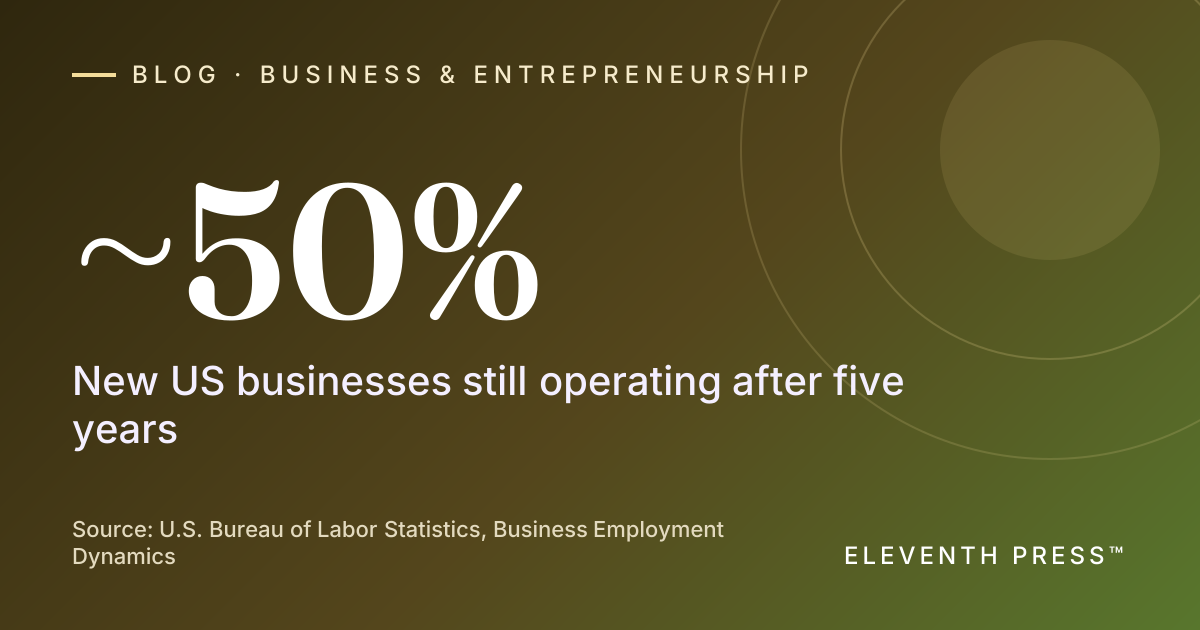
About half of new businesses fail within five years. US Bureau of Labor Statistics data show five-year survival rates for new establishments ranging from 49.8% for the 2006 cohort to 57.3% for the 2018 cohort, with firms born into recessions faring worst[1]. Globally, the Global Entrepreneurship Monitor reports record startup activity but a widening gap between starting a business and sustaining it[3].
Top 10 key takeaways
- 1Roughly half of new US establishments survive five years: 57.3% of the 2018 cohort and 49.8% of the 2006 cohort[1].
- 2Startups whose early years coincide with a recession have lower five-year survival rates[1].
- 3First-year survival was lowest for establishments born in the recession years 2001 and 2008[2].
- 4GEM finds early-stage entrepreneurship at record highs but too few ventures maturing into established firms, which it calls the “Survival Gap”[3].
- 5Entrepreneurial finance is rated insufficient in 36 of the 53 economies GEM studied[3].
- 6Fear of failure deters about two in five adults from starting a business[3].
- 7Only about one in five US firms used AI to produce goods or services in spring 2026, with large firms far ahead[4].
- 8Management quality matters: Gallup links falling manager engagement to lower productivity[5].
- 9Survival improves when founders validate demand early, manage cash closely and build management skills before scaling.
- 10Failure is common and not final; GEM finds people who have exited a business are more likely to start again[3].
How many new businesses survive?
The best long-run evidence comes from the US Bureau of Labor Statistics’ Business Employment Dynamics programme, which follows every new establishment from its first year. Five-year survival rates for startups have ranged from 49.8% for establishments born in 2006 to 57.3% for those born in 2018[1]. Put simply, about half of new businesses are still operating after five years.
Timing matters. BLS notes that startups that experience a recession during their early growth generally have lower five-year survival rates than those born during recoveries[1]. One-year survival rates were lowest for establishments born in 2001 and 2008, both recession years[2].
Is the startup survival problem global?
Yes. The Global Entrepreneurship Monitor’s 2025/2026 Global Report, covering 53 economies, finds Total early-stage Entrepreneurial Activity at record highs in many places, while the progression to established businesses older than 3.5 years is stalling[3]. GEM calls this the “Survival Gap”[3].
The conditions around founders help explain it. GEM’s national experts rated the provision of and access to entrepreneurial finance as insufficient in 36 of 53 economies, and entrepreneurship education at school was the lowest-rated condition in 33[3].
Why do new businesses fail?
Government statistics record when firms close, not why. Combining survival data with research on founders and firms, the most common causes fall into a few groups:
- No real market need: products built around an idea rather than a validated customer problem.
- Cash-flow failure: running out of money before revenue arrives, often made worse by limited access to finance[3].
- Bad timing: launching into a downturn, when demand and credit both tighten[1,2].
- Weak management: unclear roles, poor hiring and founders stretched across every function[5].
- Failure to adapt: slow adoption of tools and practices that competitors use to cut costs or reach customers[4].
Does adopting AI help small businesses survive?
It may help, but most small firms aren’t there yet. The US Census Bureau’s Business Trends and Outlook Survey found 19.8% of firms using AI in early May 2026, rising to 32% of firms with 100–249 employees and 37% of firms with 250 or more[4]. GEM warns of a possible two-tier entrepreneurial economy: in 19 of 48 economies, fewer than one in three new entrepreneurs expect AI to become very important to their business soon[3].
The practical point is not to adopt AI for its own sake, but to look for specific tasks, such as customer service, bookkeeping or marketing copy, where it can free scarce founder time, while checking its output carefully.
Why does management quality matter so much?
As a business grows past its founders, the quality of management starts to decide its fate. Gallup’s 2026 State of the Global Workplace report found global employee engagement at 20%, with a five-point fall in manager engagement driving the decline and an estimated $10 trillion in lost productivity worldwide[5]. Small firms rarely have formal management training, so the first managers they hire or promote carry outsized weight.
Is the first year the most dangerous?
Proportionally, yes. An analysis of US Census Business Dynamics Statistics estimated that roughly 77–84% of newborn establishments survived their first year, and only 42–50% survived their first five years[6]. Exit risk is highest early and falls as firms age, so the first two to three years deserve the most careful planning for cash, customers and contingencies.
How should founders handle the fear of failure?
Fear of failure deters roughly two in five adults from starting a business[3]. It can be useful when it prompts preparation rather than paralysis. One well-known technique is the project “premortem”, described by psychologist Gary Klein: before launching, the team imagines that the venture has failed and writes down every reason why, which surfaces risks that optimism hides[7]. Turning vague fear into a concrete list of risks, each with a mitigation, is a practical way to improve the odds.
Do women founders face different survival challenges?
GEM’s women’s entrepreneurship research finds that women are strongly represented among high-potential startups, leading about 40% of them, but that their activity falls sharply at the established-business stage[8]. Women were more likely than men to cite family or personal circumstances as a reason for exiting a business (20% vs 13%) and reported investing less capital on average[8]. Support that addresses access to growth finance and caregiving, not just start-up advice, targets the survival stage directly.
What should founders monitor in the first year?
Because survival risk is highest early[2,6], a short list of numbers reviewed every week is more useful than a long business plan reviewed once a quarter. The essentials are cash in the bank and months of runway; revenue against forecast; the cost of winning a customer compared with what that customer is worth; how many customers return or renew; and overdue invoices.
Watch the wider economy as well as the business. BLS data show that firms born into recessions survive at lower rates[1], so founders should have a plan for cutting costs or extending runway if demand or credit tightens. GEM’s finding that entrepreneurial finance is insufficient in most economies it studies[3] is a reason to line up financing options before they are urgently needed.
How can founders improve their odds?
The data suggest a few disciplines that consistently separate survivors from casualties:
- Validate demand before building: talk to customers, pre-sell, and test pricing.
- Plan for at least 18 months of runway and monitor cash weekly, not monthly.
- Stress-test the plan against a recession scenario; survival rates drop for firms born into downturns[1].
- Learn management early: delegation, feedback and hiring for skill rather than familiarity[5].
- Adopt proven digital and AI tools where they save time or reach customers, and measure the results[4].
- Use local support networks, mentors and public programmes to fill finance and skills gaps[3].
And if a venture does fail, the evidence is encouraging: GEM finds that people who have previously exited a business are more likely to start again[3]. Experience, including failure, is a durable asset.
Frequently asked questions
What percentage of new businesses fail in five years?
Roughly half. BLS data show five-year survival rates of 49.8% to 57.3% for recent US startup cohorts[1].
When are new businesses most likely to fail?
Survival is weakest when a firm’s early years coincide with a recession; one-year survival was lowest for establishments born in 2001 and 2008[1,2].
What is the startup “Survival Gap”?
GEM’s term for record levels of early-stage entrepreneurship combined with too few ventures becoming established businesses[3].
How many small businesses use AI?
The US Census Bureau found 19.8% of firms using AI in early May 2026, with much higher rates among larger firms[4].
Does failing in business make you less likely to succeed later?
Not necessarily. GEM finds that people who have previously exited a business are more likely to start again[3].
Sources & references
- 1.U.S. Bureau of Labor Statistics. (2024). Business Employment Dynamics twentieth anniversary! Spotlight on Statistics. www.bls.gov/spotlight/2024/business-employment-dynamics-twentieth-anniversary/home.htm
- 2.U.S. Bureau of Labor Statistics. (2024). 1-year survival rates for new business establishments by year and location. The Economics Daily. www.bls.gov/opub/ted/2024/1-year-survival-rates-for-new-business-establishments-by-year-and-location.htm
- 3.Global Entrepreneurship Monitor. (2026). GEM 2025/2026 global report: From uncertainty to opportunity. GERA. www.gemconsortium.org/reports/latest-global-report
- 4.U.S. Census Bureau. (2026, May). Large firms with at least 20 employees biggest AI users. www.census.gov/library/stories/2026/05/ai-use-businesses.html
- 5.Gallup. (2026). State of the global workplace: 2026 report. Gallup, Inc. www.gallup.com/workplace/349484/state-of-the-global-workplace.aspx
- 6.The risk of death in newborn businesses during the first years in market. (2020). arXiv:2011.11776. arxiv.org/abs/2011.11776
- 7.Klein, G. (2007). Performing a project premortem. Harvard Business Review, 85(9), 18–19. hbr.org/2007/09/performing-a-project-premortem
- 8.Global Entrepreneurship Monitor. (2026). GEM 2025/2026 women’s entrepreneurship report: How metrics shape the narrative. GERA. www.gemconsortium.org/reports/womens-entrepreneurship
Editorial standards: every figure in this post is taken from the source cited beside it, primary sources first. Spotted an error? Write to editorial@eleventhpress.com and we will correct it.