Blog · Health & Fitness
How Many Steps a Day Do You Really Need? The Science of Exercise, Explained
Ten thousand steps was a marketing number. The latest meta-analyses point to about 7,000, show that intensity and short bursts matter, and explain what WHO guidelines actually ask of you.
By the Editorial Office 6 min read9 sources
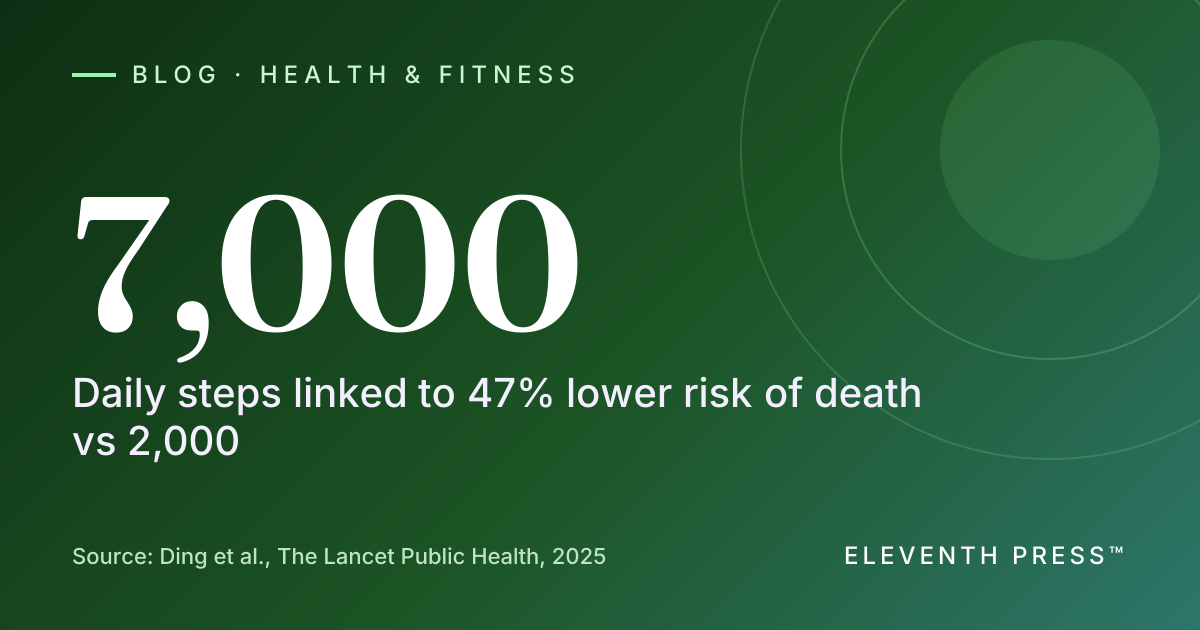
For most adults, about 7,000 steps a day captures most of the health benefit of walking. A 2025 meta-analysis of 57 studies found that 7,000 steps a day, compared with 2,000, was associated with a 47% lower risk of death from any cause[1]. Benefits continue beyond that but level off, and WHO’s core advice remains 150–300 minutes of moderate activity a week plus strength training[3].
Top 10 key takeaways
- 1The 10,000-steps target has no special scientific basis; it became popular through marketing rather than research.
- 2A 2025 Lancet Public Health meta-analysis of 57 studies found 7,000 steps a day associated with a 47% lower risk of all-cause death than 2,000 steps[1].
- 3The same analysis linked 7,000 steps with 25% lower cardiovascular disease incidence, 38% lower dementia risk and 22% fewer depressive symptoms[1].
- 4Going from 7,000 to 10,000 steps brings additional but smaller gains, so 10,000 remains a fine goal for people who are already active[1].
- 5A 2022 meta-analysis found mortality benefits plateau at about 6,000–8,000 steps for adults aged 60+ and 8,000–10,000 for younger adults[2].
- 6Even small increases help: rising from about 2,000 to 4,000 steps a day is associated with meaningful health gains[1,6].
- 7WHO recommends 150–300 minutes of moderate or 75–150 minutes of vigorous aerobic activity a week, plus muscle strengthening on two or more days[3].
- 8Short bursts count: about three 1–2-minute bouts of vigorous daily activity were linked with markedly lower mortality among non-exercisers[5].
- 9About 31% of adults, nearly 1.8 billion people, were insufficiently active in 2022[4].
- 10These are observational associations; they show strong, consistent links, not proof that steps alone cause better health.
Where did the 10,000-steps goal come from?
The round number is usually traced to a 1960s Japanese pedometer marketed under a name meaning “10,000-step meter”. It was a memorable slogan, not a target derived from health outcomes. Only in the last decade, as wearables made it possible to measure steps in large cohorts, have researchers been able to test which step counts are actually associated with longer, healthier lives.
What does the latest research say about daily steps?
The most comprehensive answer comes from a systematic review and dose-response meta-analysis led by Melody Ding of the University of Sydney, published in The Lancet Public Health in 2025[1]. It pooled 57 studies that measured steps with devices and followed people over time for outcomes including death, cardiovascular disease, cancer, diabetes, dementia, depression and falls[1].
Compared with 2,000 steps a day, 7,000 steps was associated with a 47% lower risk of death from any cause, a 25% lower incidence of cardiovascular disease, a 38% lower risk of dementia and a 22% reduction in depressive symptoms[1,6]. The authors concluded that 7,000 steps a day is associated with clinically meaningful improvements and is a realistic target, while 10,000 remains worthwhile for those who are more active[1].
An earlier meta-analysis of 15 cohorts by Amanda Paluch and the Steps for Health Collaborative reached a similar shape of curve: risk of death fell progressively with more steps and then levelled off, at about 6,000–8,000 steps a day for adults aged 60 and over and 8,000–10,000 for younger adults[2].
Do more steps always mean better health?
More is generally better, but with diminishing returns. In the 2025 analysis, the additional reduction in mortality risk between 7,000 and 10,000 steps was much smaller than the reduction between 2,000 and 7,000[1,6]. For people who currently move very little, the message is encouraging: the steepest part of the curve is at the bottom, and even 2,000 extra steps a day is associated with meaningful benefit[1,6].
Two caveats matter. First, these are observational studies; healthier people may walk more, and statistical adjustment cannot remove every confounder. Second, the evidence is stronger for some outcomes, such as all-cause mortality, than others, such as dementia, where fewer studies were available[1].
What do WHO physical-activity guidelines recommend?
WHO’s 2020 guidelines do not set a step count. For adults they recommend 150–300 minutes of moderate-intensity aerobic activity a week, or 75–150 minutes of vigorous activity, or an equivalent mix, plus muscle-strengthening activities involving all major muscle groups on two or more days a week[3]. Older adults are also advised to include balance training to prevent falls[3]. Crucially, the guidelines state that some physical activity is better than none[3].
Most people are not there yet. WHO-led estimates found that 31% of adults worldwide, nearly 1.8 billion people, did not meet the guidelines in 2022[4].
Does intensity matter as much as volume?
Yes. Brisk walking counts as moderate activity, and short vigorous efforts appear to punch above their weight. A Nature Medicine study of more than 25,000 UK Biobank participants who did no leisure-time exercise found that around three short bouts of vigorous intermittent lifestyle physical activity a day, each lasting one to two minutes (climbing stairs quickly, carrying heavy shopping, a fast walk to the bus), were associated with substantially lower all-cause, cancer and cardiovascular mortality[5].
Why does strength training matter as well as walking?
Walking mainly trains the heart and lungs. Muscle-strengthening activity protects muscle mass, bone density and the ability to live independently in later life, which is why WHO recommends it on at least two days a week for all adults[3]. A meta-analysis by Haruki Momma and colleagues found that 30–60 minutes a week of muscle-strengthening activity was associated with a 10–20% lower risk of death from any cause, cardiovascular disease and cancer, independent of aerobic activity[7].
How strong is the evidence that steps cause better health?
Step studies are prospective cohorts: researchers measure steps once, then follow participants for years. That design rules out some biases but not all. People who are already unwell walk less, so part of the association can run backwards; this is why good studies exclude early deaths and adjust for existing illness[1,2]. Published correspondence on the 2025 meta-analysis also notes that a single baseline measurement can blur the true relationship, and that adjusting for factors such as body weight or diabetes, which lie on the causal pathway, can distort estimates[8].
Despite these caveats, the picture is consistent across countries, devices and outcomes, and it matches evidence from trials showing that exercise improves blood pressure, blood sugar control and fitness. The safest reading is that more daily movement very likely improves health, and that the precise percentages should be treated as estimates rather than guarantees.
Why are so many people still inactive?
Knowing the benefits has not been enough. Papers published in Nature Health and Nature Medicine in 2026 found that global levels of physical activity have not improved over two decades, despite more countries adopting physical-activity policies[9]. Barriers include long working hours, car-dependent neighbourhoods, unsafe streets and the cost of facilities, which is why public-health researchers increasingly focus on environments as well as individual willpower[9].
How can you build more activity into a busy day?
The evidence supports simple, cumulative changes rather than an all-or-nothing programme:
- Find your baseline with a phone or wearable for a week, then add 1,000 steps a day each week until you reach about 7,000[1].
- Make some of those steps brisk; a pace that makes conversation slightly harder counts as moderate activity[3].
- Add two short strength sessions a week, using body weight, bands or weights[3].
- Use stairs and fast short walks as deliberate vigorous bursts[5].
- Break up long periods of sitting, which WHO also advises limiting[3].
If you have a heart condition, are pregnant or have been inactive for a long time, talk to a health professional before sharply increasing intensity.
Frequently asked questions
Is 7,000 steps a day enough?
For most adults it captures most of the benefit. A 2025 meta-analysis linked 7,000 steps with a 47% lower risk of death than 2,000 steps; going higher adds smaller extra benefits[1].
Is the 10,000-steps rule a myth?
It isn’t harmful, but it isn’t a threshold either. Benefits start well below 10,000 and level off at roughly 6,000–8,000 steps for older adults and 8,000–10,000 for younger adults[2].
How many minutes of exercise does WHO recommend?
150–300 minutes of moderate or 75–150 minutes of vigorous aerobic activity a week, plus muscle strengthening on two or more days[3].
Do short bursts of exercise count?
Yes. Short vigorous bouts of 1–2 minutes, done about three times a day, were associated with lower mortality among people who didn’t otherwise exercise[5].
Does walking help mental health?
The 2025 meta-analysis associated 7,000 steps a day with a 22% reduction in depressive symptoms compared with 2,000 steps[1].
Sources & references
- 1.Ding, D., Nguyen, B., Nau, T., et al. (2025). Daily steps and health outcomes in adults: A systematic review and dose-response meta-analysis. The Lancet Public Health, 10(8), e668–e681. doi.org/10.1016/S2468-2667(25)00164-1
- 2.Paluch, A. E., Bajpai, S., Bassett, D. R., et al. (2022). Daily steps and all-cause mortality: A meta-analysis of 15 international cohorts. The Lancet Public Health, 7(3), e219–e228. doi.org/10.1016/S2468-2667(21)00302-9
- 3.Bull, F. C., Al-Ansari, S. S., Biddle, S., et al. (2020). World Health Organization 2020 guidelines on physical activity and sedentary behaviour. British Journal of Sports Medicine, 54(24), 1451–1462. doi.org/10.1136/bjsports-2020-102955
- 4.World Health Organization. (2024, June 26). Nearly 1.8 billion adults at risk of disease from not doing enough physical activity [News release]. www.who.int/news/item/26-06-2024-nearly-1.8-billion-adults-at-risk-of-disease-from-not-doing-enough-physical-activity
- 5.Stamatakis, E., Ahmadi, M. N., Gill, J. M. R., et al. (2022). Association of wearable device-measured vigorous intermittent lifestyle physical activity with mortality. Nature Medicine, 28(12), 2521–2529. doi.org/10.1038/s41591-022-02100-x
- 6.The University of Sydney. (2025, July 24). Rethink the 10,000-a-day step goal, study suggests [News release]. www.sydney.edu.au/news-opinion/news/2025/07/24/rethink-the-10000-a-day-step-goal-study-suggests.html
- 7.Momma, H., Kawakami, R., Honda, T., & Sawada, S. S. (2022). Muscle-strengthening activities are associated with lower risk and mortality in major non-communicable diseases: A systematic review and meta-analysis of cohort studies. British Journal of Sports Medicine, 56(13), 755–763. doi.org/10.1136/bjsports-2021-105061
- 8.Reflections on daily steps and health outcomes [Correspondence]. (2025). The Lancet Public Health. www.thelancet.com/journals/lanpub/article/PIIS2468-2667(25)00246-4/fulltext
- 9.Springer Nature. (2026, March). Health: Global physical activity levels have not improved over 20 years (Nature Medicine, Nature Health) [Press release]. Nature Asia. www.natureasia.com/en/info/press-releases/detail/9261
Editorial standards: every figure in this post is taken from the source cited beside it, primary sources first. Spotted an error? Write to editorial@eleventhpress.com and we will correct it.