Blog · Technology
Does Generative AI Really Make Us More Productive? What the Best Evidence Shows
Randomised trials and field studies find real gains, largest for less experienced workers, but also a “jagged frontier” where AI makes people worse. A guide to the evidence and what it means for teams.
By the Editorial Office 7 min read5 sources
Yes, on the right tasks. The strongest studies find that generative AI raised customer-support productivity by 14% on average and by 34% for novices[1], cut the time professionals spent on writing tasks by 40% while raising quality by 18%[2], and helped consultants finish 12.2% more tasks, 25.1% faster[3]. On tasks outside the AI’s capability, the same consultants were 19 percentage points less likely to get the right answer[3].
Top 10 key takeaways
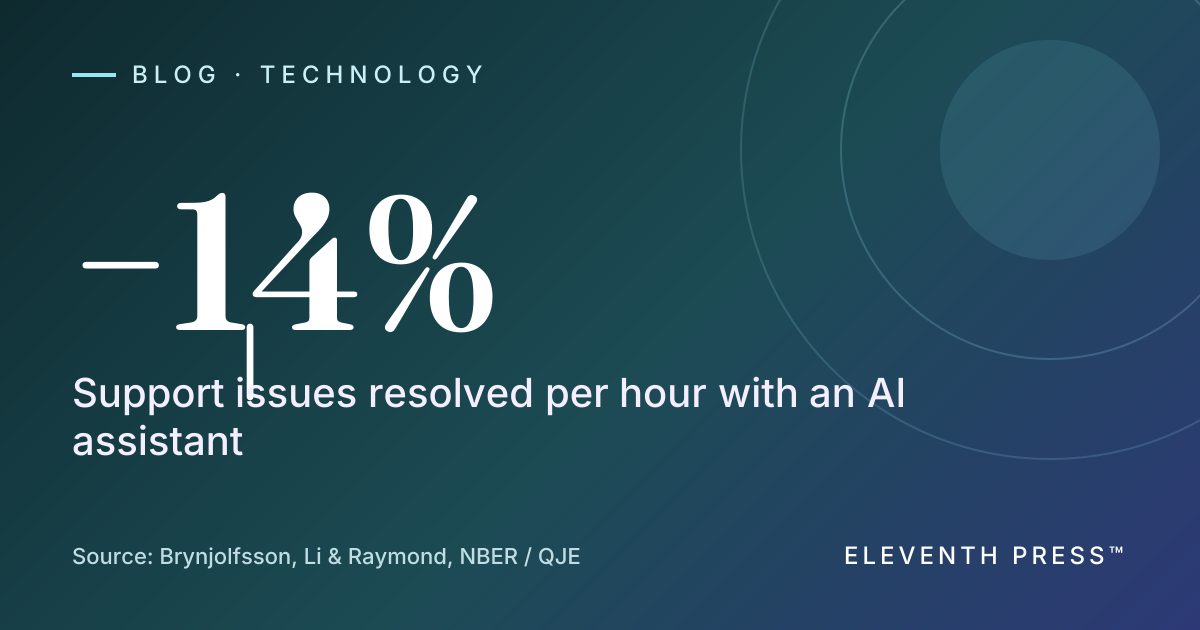
- 1In a field study of more than 5,000 customer-support agents, an AI assistant raised issues resolved per hour by 14% on average[1].
- 2The gains were largest for novice and lower-skilled agents (34%) and minimal for the most experienced[1].
- 3In a randomised experiment, ChatGPT cut the time college-educated professionals took on writing tasks by 40% and raised rated quality by 18%[2].
- 4Consultants at Boston Consulting Group using GPT-4 completed 12.2% more tasks, 25.1% faster, with more than 40% higher rated quality, on tasks within AI’s capability[3].
- 5On a task deliberately chosen to be outside AI’s capability, consultants using AI were 19 percentage points less likely to produce a correct solution[3].
- 6Researchers call this uneven pattern a “jagged technological frontier”: tasks that look equally hard to humans can fall on opposite sides of AI’s ability[3].
- 7Adoption is broad but shallow: generative AI reached 53% population adoption within three years[4], yet about one in five US firms used AI in production in spring 2026[5].
- 8Benchmarks overstate everyday reliability; agents still fail roughly one in three attempts on structured tasks[4].
- 9Productivity gains depend on verification: writing-study participants did not fact-check output, so speed gains in real work are smaller[2].
- 10The practical lesson is to map tasks, measure outcomes and keep humans accountable rather than to adopt or ban AI wholesale.
Why is the evidence on AI productivity so mixed?
Headlines swing between “AI doubles output” and “AI is overhyped” because they often rely on surveys, vendor case studies or benchmark scores. The studies worth paying attention to have a control group: workers who did the same tasks without AI, so differences can be attributed to the tool. Three such studies, published in leading economics and science outlets, form the core of what we know.
Each measures something different (support tickets resolved, writing time and quality, consulting deliverables), and each covers a specific task in a specific setting. Read together, they tell a consistent story about who benefits, on which tasks, and where the risks lie.
What happened when customer-support agents got an AI assistant?
Erik Brynjolfsson, Danielle Li and Lindsey Raymond studied the staggered rollout of a generative AI conversational assistant to more than 5,000 customer-support agents at a software firm[1]. Because the tool reached different agents at different times, the researchers could compare similar workers with and without it.
Access to the assistant increased the number of issues resolved per hour by 14% on average[1]. The effect was concentrated among novice and lower-skilled workers, whose productivity rose by 34%, while the most experienced and skilled agents saw minimal gains[1]. The authors interpret this as the AI spreading the tacit know-how of top performers to newer staff. They also report improvements in customer sentiment and employee retention[1].
Does ChatGPT make professional writing faster and better?
Shakked Noy and Whitney Zhang ran a pre-registered online experiment in which 453 college-educated professionals completed occupation-specific writing tasks such as press releases and short reports, with half given access to ChatGPT[2]. Independent evaluators in the same occupations graded the work.
Access to ChatGPT decreased the time taken by 40% and raised output quality by 18%[2]. As in the support study, the tool compressed differences between workers: weaker writers benefited most. The authors caution that participants did not fact-check, so real-world speed gains will be smaller once verification is included[2].
What is the “jagged technological frontier”?
The most instructive study comes from a randomised experiment with 758 consultants at Boston Consulting Group, run by researchers from Harvard, MIT, Wharton and Warwick[3]. Consultants worked on realistic tasks either with or without GPT-4.
On a set of creative product-development tasks within the AI’s capability, consultants using AI completed 12.2% more tasks, finished 25.1% more quickly and produced work rated more than 40% higher in quality[3]. On a business-analysis task deliberately designed to sit just outside the AI’s capability, where the model gave a confident but wrong answer, consultants using AI were 19 percentage points less likely to reach the correct solution than those working alone[3].
The authors call this a jagged frontier: tasks that look similarly difficult to people can fall on opposite sides of what AI does well[3]. The danger is not that AI fails, but that it fails convincingly, and people who trust it stop checking.
How widely are businesses actually using AI?
Individual use has spread at record speed: Stanford’s 2026 AI Index reports that generative AI reached 53% population adoption within three years[4]. Firm-level use for producing goods and services is lower. The US Census Bureau’s Business Trends and Outlook Survey found 19.8% of firms using AI in early May 2026, with large firms and the information and finance sectors far ahead of retail[5].
The same AI Index documents capabilities that are impressive but uneven: near-human scores on hard coding benchmarks alongside agents that still fail roughly one in three attempts on structured tasks[4]. That profile is the jagged frontier at industry scale.
Why do less experienced workers gain the most?
All three studies find that AI narrows the gap between stronger and weaker performers[1,2,3]. In the customer-support study, agents with two months of tenure who had the AI assistant performed about as well as agents with more than six months of tenure who did not[1]. The authors’ explanation is that the assistant had learned from the conversations of the firm’s best agents, so it passed their tacit know-how, such as how to phrase an apology or which troubleshooting step to try first, on to newcomers in real time[1].
This has two implications for organisations. Onboarding can be faster and less stressful, which may be one reason the study found improved retention[1]. But if junior staff lean on AI for exactly the tasks through which people traditionally learned a profession, organisations need to design deliberate practice and mentoring so that expertise still develops.
What are “centaurs” and “cyborgs”?
Observing how the BCG consultants actually worked, Dell’Acqua and colleagues identified two successful styles[3]. “Centaurs” divided the work, handing specific sub-tasks to the AI and keeping others, such as judgement calls, for themselves. “Cyborgs” wove AI through every step, iterating with it continuously[3]. Both styles can work; what distinguished poor outcomes was uncritical acceptance of output on tasks outside the frontier[3].
What don’t these studies tell us?
Each study is a snapshot of particular tasks, measured over weeks or months, often with models that have since been superseded. Writing quality was judged by graders rather than by real-world results, and participants in the writing experiment did not fact-check[2]. Gains in a controlled task also do not translate automatically into firm- or economy-wide productivity, which depends on reorganising workflows, retraining staff and managing new risks.
Capability is moving quickly too. Stanford’s AI Index reports that performance on the SWE-bench Verified coding benchmark rose from 60% to near 100% of the human baseline in one year[4]. Organisations should therefore treat any study’s numbers as a floor for what is possible on similar tasks, and as no guarantee of reliability on theirs.
How should teams use generative AI responsibly?
The research points to a handful of practical rules for managers and individual professionals:
- Map tasks, not jobs. Break work into tasks and test AI on each, because performance varies sharply within a single role[3].
- Expect the biggest gains for newcomers, and pair AI with mentoring so that novices learn the reasoning, not just the output[1].
- Build verification into the workflow. Fact-checking, source checks and peer review are where the time saved is partly spent[2].
- Measure outcomes such as resolution rates, error rates and customer satisfaction, not hours saved alone[1].
- Keep a named human accountable for every AI-assisted decision, especially in high-stakes or regulated work.
Used this way, generative AI behaves less like a replacement for expertise and more like a fast, fallible junior colleague whose work always needs a second look.
Frequently asked questions
How much does generative AI increase productivity?
In rigorous studies, gains range from 14% more customer issues resolved per hour[1] to 40% less time on writing tasks[2] and 12.2% more consulting tasks completed[3]. Results depend heavily on the task.
Who benefits most from AI at work?
Less experienced and lower-performing workers. In customer support, novices gained 34% while top performers saw little change[1]; weaker writers also gained most in the ChatGPT experiment[2].
Can AI make work worse?
Yes. On a task outside the AI’s capability, consultants using GPT-4 were 19 percentage points less likely to produce a correct answer[3].
What share of businesses use AI?
The US Census Bureau found 19.8% of US firms using AI to produce goods or services in early May 2026, with higher rates among large firms[5].
What is the jagged technological frontier?
A term from the BCG field experiment describing how AI’s abilities are uneven: tasks of similar difficulty for humans may be easy or impossible for AI[3].
Sources & references
- 1.Brynjolfsson, E., Li, D., & Raymond, L. R. (2023). Generative AI at work (NBER Working Paper No. 31161). National Bureau of Economic Research. Published in The Quarterly Journal of Economics, 140(2), 889–942 (2025). www.nber.org/papers/w31161
- 2.Noy, S., & Zhang, W. (2023). Experimental evidence on the productivity effects of generative artificial intelligence. Science, 381(6654), 187–192. doi.org/10.1126/science.adh2586
- 3.Dell’Acqua, F., McFowland, E., III, Mollick, E. R., Lifshitz-Assaf, H., Kellogg, K., Rajendran, S., Krayer, L., Candelon, F., & Lakhani, K. R. (2023). Navigating the jagged technological frontier: Field experimental evidence of the effects of AI on knowledge worker productivity and quality (Harvard Business School Working Paper No. 24-013). mitsloan.mit.edu/sites/default/files/2023-10/SSRN-id4573321.pdf
- 4.Stanford HAI. (2026). Inside the AI Index: 12 takeaways from the 2026 report. hai.stanford.edu/news/inside-the-ai-index-12-takeaways-from-the-2026-report
- 5.U.S. Census Bureau. (2026, May). Large firms with at least 20 employees biggest AI users. www.census.gov/library/stories/2026/05/ai-use-businesses.html
Editorial standards: every figure in this post is taken from the source cited beside it, primary sources first. Spotted an error? Write to editorial@eleventhpress.com and we will correct it.