Blog · Education & Psychology
The Science of Learning: Why Retrieval Practice and Spacing Beat Rereading
Decades of cognitive psychology show that the study habits students like most, rereading and highlighting, work least. Here is what works, why, and how teachers and learners can use it.
By the Editorial Office 6 min read8 sources
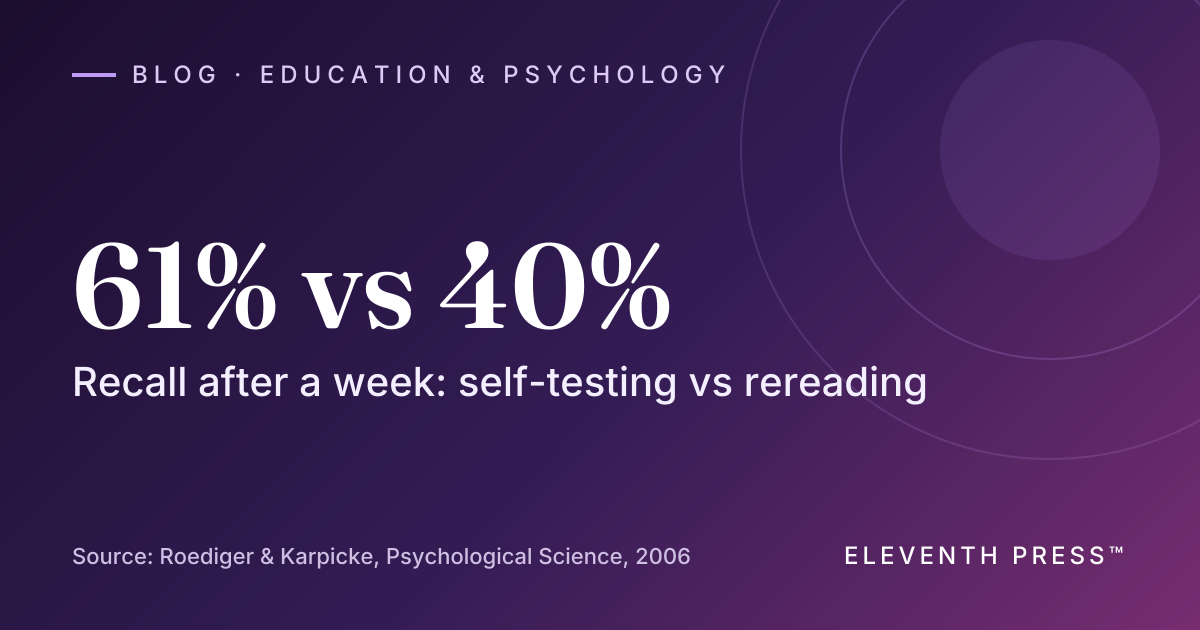
The two most effective study techniques are practice testing (retrieval practice) and distributed practice (spacing study over time); a landmark review of ten common techniques rated only these two as “high utility”, while rereading, highlighting and summarising rated low[1]. In one classic experiment, students who repeatedly tested themselves recalled 61% of a passage a week later, against 40% for students who repeatedly reread it[2].
Top 10 key takeaways
- 1A 2013 review of ten learning techniques rated only practice testing and distributed practice as high utility[1].
- 2Highlighting, rereading and summarising, the techniques students use most, were rated low utility[1].
- 3In a classic experiment, repeated self-testing produced 61% recall after one week versus 40% for repeated studying[2].
- 4Students who reread felt more confident, even though they remembered less: fluency is not the same as learning[2].
- 5Retrieval practice outperformed elaborative concept mapping for learning science texts[4].
- 6A meta-analysis of 272 effect sizes found practice tests more beneficial for learning than restudying and other comparison conditions[5].
- 7Spacing study sessions apart improves long-term retention compared with massing them together, across hundreds of experiments[3].
- 8The best gap between sessions grows with how long you need to remember the material[3].
- 9Interleaving, elaborative interrogation and self-explanation have moderate evidence and are useful complements[1].
- 10These techniques help motivated learners who use them; they are not a substitute for good teaching or sufficient time[1].
Why do popular study habits fail?
Rereading and highlighting feel productive. The material looks familiar the second time, and familiarity is easily mistaken for mastery. Cognitive psychologists call this an illusion of fluency. The trouble is that exams, jobs and life ask us to recall and use knowledge, not to recognise it on a page.
In 2013 John Dunlosky and colleagues reviewed hundreds of studies on ten techniques that students commonly use, judging each on how well it works across learners, materials and tasks[1]. Highlighting and underlining, rereading and summarisation were rated low utility. Only two techniques earned a high-utility rating: practice testing and distributed practice[1,6].
What is retrieval practice?
Retrieval practice means pulling information out of memory rather than putting it back in: answering questions, using flashcards, writing down everything you remember about a topic, or explaining it without notes. Each act of recall strengthens the memory and makes it easier to retrieve again, a finding known as the testing effect.
Henry Roediger and Jeffrey Karpicke demonstrated the effect vividly in 2006[2]. Students studied prose passages under different schedules. After one week, those who had studied once and then tested themselves three times recalled 61% of the material, while those who had studied four times recalled 40%[2]. Strikingly, the rereaders predicted they would remember more[2].
The advantage holds against richer strategies too. Karpicke and Blunt found that students who practised retrieval learned science texts better than students who built detailed concept maps, even on tests that asked them to draw concept maps[4]. A 2017 meta-analysis by Adesope, Trevisan and Sundararajan, covering 272 independent effect sizes, concluded that practice tests are more beneficial for learning than restudying and all other comparison conditions[5].
How does spaced repetition work?
Distributed or spaced practice means spreading study over several sessions rather than cramming it into one. A meta-analysis by Nicholas Cepeda and colleagues, drawing on hundreds of experiments, confirmed that spacing improves long-term retention compared with massed study[3]. It also found that the optimal gap between sessions depends on how long you need to remember: material needed for a test next week benefits from shorter gaps than material you want to retain for a year[3].
Spacing works partly because it forces effortful retrieval. When some forgetting has happened, recalling the material takes more work, and that work is what makes the memory durable. This is why spaced retrieval, testing yourself at increasing intervals, combines the two most powerful techniques.
Which other techniques have good evidence?
Dunlosky’s review rated three further techniques as moderate utility: interleaved practice (mixing different types of problems in one session), elaborative interrogation (asking “why is this true?”) and self-explanation (explaining how new information relates to what you know)[1]. They are worth adding once testing and spacing are in place.
Does retrieval practice work in real classrooms?
Laboratory findings do not always survive the messiness of real schools, so researchers have tested retrieval practice in classrooms directly. A systematic review of applied research by Pooja Agarwal and colleagues found that retrieval practice consistently benefited student learning in schools and classrooms, across grade levels, subjects and types of test[7].
It also need not raise stress. In a survey of middle- and high-school students who used frequent low-stakes quizzes, 72% reported that retrieval practice made them less nervous about unit tests and exams[8]. Framed as practice rather than judgement, quizzing builds both memory and confidence.
Why does effortful study feel worse but work better?
Learners consistently misjudge which strategies help them. In Roediger and Karpicke’s study, students who reread predicted better recall than students who tested themselves, the opposite of what happened a week later[2]. Rereading produces a sense of fluency in the moment; retrieval produces struggle and visible gaps. Because people tend to choose strategies that feel productive, effective techniques need to be built into routines, timetables and course design rather than left to preference.
Can apps and AI tools help?
Spaced-repetition flashcard software automates the scheduling that Cepeda’s meta-analysis supports, showing each item again just as it is about to be forgotten[3]. Generative AI can quickly produce practice questions from course notes. The principle to protect is that the learner must try to answer before seeing the answer: reading AI-written summaries or explanations is a form of rereading, while being quizzed by an AI tutor is a form of retrieval practice[1,2].
What does an evidence-based revision plan look like?
Suppose a student has four weeks before an exam. A plan built on the evidence would look like this: in week one, learn each topic and finish every study session by closing the notes and writing down what can be recalled[2,4]. From week two, begin each session with a short self-quiz on earlier topics before moving on, so that old material is retrieved at growing intervals[3]. Problem sets mix question types from different chapters rather than practising one type at a time[1]. In the final week, full practice papers under exam conditions replace rereading altogether[1,5].
The total study time need not increase. What changes is how the time is used: less time looking at material, more time trying to produce it from memory, spread across more days[1,3].
How can teachers and learners apply the evidence?
The techniques are simple, cheap and work across subjects. Practical ways to use them:
- Start lessons with low-stakes quizzes on material from previous weeks, combining retrieval with spacing[1,2].
- Replace rereading with the blank-page method: close the book and write or sketch everything you can recall, then check the gaps[2,4].
- Use flashcards and keep reviewing the cards you know, at growing intervals, rather than dropping them[3].
- Plan study across days and weeks; the longer you need the knowledge, the longer the gaps can be[3].
- Give feedback on practice questions, which supports correction of errors[5].
- Mix problem types in homework so students practise choosing a method, not just applying one[1].
Expect the techniques to feel harder than rereading. That difficulty is a feature: it is the effort of retrieval that builds lasting memory.
Frequently asked questions
What is the most effective way to study?
Practice testing (retrieval practice) and distributed practice (spacing) are the two techniques rated high utility in a major review of learning research[1].
Is rereading notes a good way to study?
Not on its own. Rereading was rated low utility[1], and in a classic experiment repeated rereading produced 40% recall after a week versus 61% for repeated self-testing[2].
What is the testing effect?
The finding that retrieving information from memory strengthens learning more than restudying it[2,5].
How far apart should study sessions be?
It depends on how long you need to remember the material; longer retention benefits from longer gaps between sessions[3].
Does highlighting help learning?
The evidence is weak; highlighting and underlining were rated low utility[1].
Sources & references
- 1.Dunlosky, J., Rawson, K. A., Marsh, E. J., Nathan, M. J., & Willingham, D. T. (2013). Improving students’ learning with effective learning techniques: Promising directions from cognitive and educational psychology. Psychological Science in the Public Interest, 14(1), 4–58. doi.org/10.1177/1529100612453266
- 2.Roediger, H. L., III, & Karpicke, J. D. (2006). Test-enhanced learning: Taking memory tests improves long-term retention. Psychological Science, 17(3), 249–255. doi.org/10.1111/j.1467-9280.2006.01693.x
- 3.Cepeda, N. J., Pashler, H., Vul, E., Wixted, J. T., & Rohrer, D. (2006). Distributed practice in verbal recall tasks: A review and quantitative synthesis. Psychological Bulletin, 132(3), 354–380. doi.org/10.1037/0033-2909.132.3.354
- 4.Karpicke, J. D., & Blunt, J. R. (2011). Retrieval practice produces more learning than elaborative studying with concept mapping. Science, 331(6018), 772–775. doi.org/10.1126/science.1199327
- 5.Adesope, O. O., Trevisan, D. A., & Sundararajan, N. (2017). Rethinking the use of tests: A meta-analysis of practice testing. Review of Educational Research, 87(3), 659–701. doi.org/10.3102/0034654316689306
- 6.Association for Psychological Science. (2013). Which study strategies make the grade? [News release]. www.psychologicalscience.org/news/releases/which-study-strategies-make-the-grade.html
- 7.Agarwal, P. K., Nunes, L. D., & Blunt, J. R. (2021). Retrieval practice consistently benefits student learning: A systematic review of applied research in schools and classrooms. Educational Psychology Review, 33(4), 1409–1453. doi.org/10.1007/s10648-021-09595-9
- 8.Agarwal, P. K., D’Antonio, L., Roediger, H. L., III, McDermott, K. B., & McDaniel, M. A. (2014). Classroom-based programs of retrieval practice reduce middle school and high school students’ test anxiety. Journal of Applied Research in Memory and Cognition, 3(3), 131–139. doi.org/10.1016/j.jarmac.2014.07.002
Editorial standards: every figure in this post is taken from the source cited beside it, primary sources first. Spotted an error? Write to editorial@eleventhpress.com and we will correct it.