Blog · Research
Research Integrity in the Paper-Mill Era: What Record Retractions Mean for Science
More than 10,000 papers were retracted in 2023, and organised fraud is growing faster than legitimate science. How we got here, how the scholarly record is fighting back, and what authors and readers can do.
By the Editorial Office 6 min read8 sources
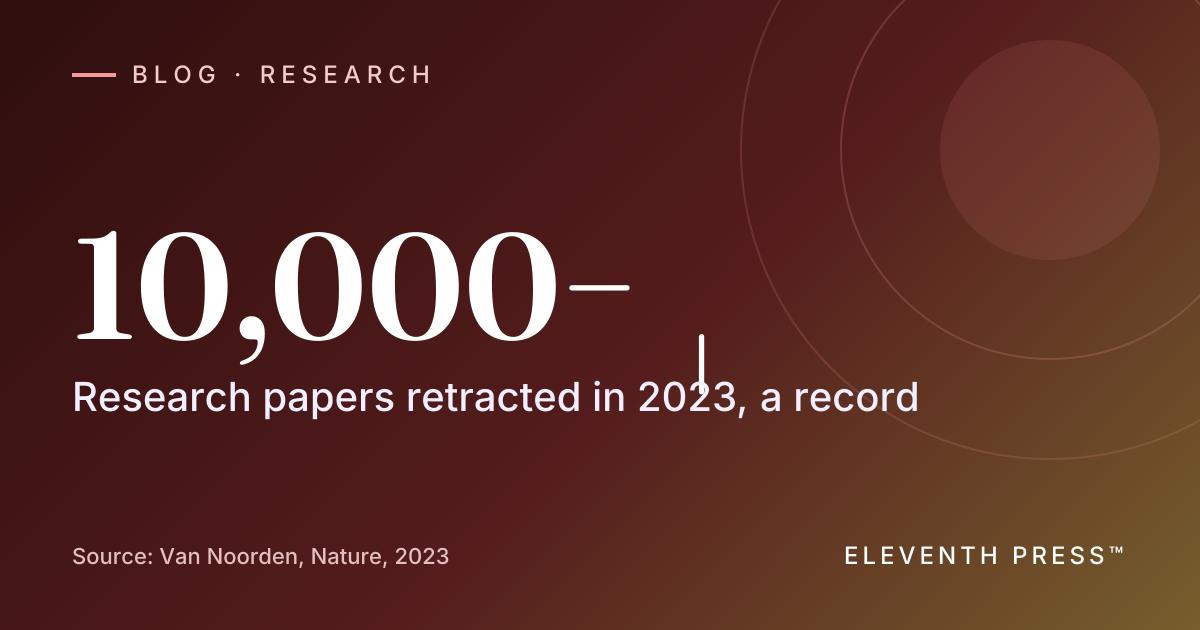
Retractions reached a record in 2023, when more than 10,000 research papers were withdrawn, over 8,000 of them from journals owned by Hindawi[1]. A 2025 PNAS study found that the networks producing fraudulent papers at scale are large, resilient and growing faster than legitimate science[3]. Most retractions are caused by misconduct rather than honest error[2].
Top 10 key takeaways
- 1More than 10,000 research papers were retracted in 2023, a record[1].
- 2Over 8,000 of those retractions came from journals owned by Hindawi, then part of Wiley[1].
- 3A classic analysis of 2,047 retracted biomedical papers found 67.4% were retracted for misconduct and 21.3% for error[2].
- 4Fraud or suspected fraud accounted for 43.4% of those retractions, duplicate publication 14.2% and plagiarism 9.8%[2].
- 5A 2025 PNAS study assembled a corpus of 32,786 suspected paper-mill papers[3].
- 6The authors found fraudulent output growing faster than legitimate science, with brokers able to place articles on demand[3].
- 7Paper mills adapt quickly: new outlets appear as soon as compromised journals are deindexed[3].
- 8Publishers, COPE and STM have issued shared guidance on recognising and handling paper-mill manuscripts[4].
- 9The Retraction Watch database, now openly available through Crossref, lets anyone check whether a paper has been retracted[5].
- 10Authors and readers can protect the record with simple checks before citing, submitting or relying on a paper.
How many scientific papers are retracted?
Retractions remain a small share of the literature, but the trend is steep. A Nature analysis by Richard Van Noorden reported that the number of retractions issued for research articles passed 10,000 in 2023, a new record[1]. The single largest contributor was Hindawi, which retracted more than 8,000 articles that year after discovering compromised special issues and peer review[1]. Experts quoted by Nature warned that the true scale of problematic papers is likely larger[1].
Are retractions caused by fraud or honest error?
Mostly misconduct. In a landmark 2012 study, Ferric Fang, R. Grant Steen and Arturo Casadevall reviewed all 2,047 biomedical and life-science articles indexed as retracted in PubMed and checked the reasons behind vague retraction notices[2]. They found that 67.4% were attributable to misconduct (fraud or suspected fraud, 43.4%; duplicate publication, 14.2%; plagiarism, 9.8%) and only 21.3% to error[2]. Uninformative notices had previously hidden much of the fraud[2].
What are paper mills?
Paper mills are businesses that sell authorship on fabricated or plagiarised manuscripts, sometimes alongside manipulated images, fake data and arranged peer review. A joint report from COPE and the STM publishers’ association described the problem and set out how editors can recognise telltale patterns[4].
A 2025 study in PNAS by Reese Richardson, Luís Amaral and colleagues examined how these operations work at scale[3]. The team compiled a corpus of 32,786 suspected paper-mill products and identified broker organisations able to place articles in journals on demand, as well as networks of editors who channelled submissions to one another[3]. The authors conclude that the enterprise is evading interventions and that fraudulent publications are growing faster than legitimate science; when compromised journals are deindexed, new outlets appear in their place[3].
Why does a corrupted record matter beyond academia?
Science builds on itself. Fabricated findings get cited, pooled into meta-analyses and used to justify new experiments, clinical trials and policies. Each fraudulent paper consumes reviewer time and funding and erodes trust in the honest work around it. Retracted papers can also keep being cited for years after withdrawal, especially when the retraction is not clearly flagged.
Is generative AI making research fraud worse?
It lowers the cost of producing plausible text and images, which is exactly what paper mills sell. Detection has had to evolve. Guillaume Cabanac, Cyril Labbé and Alexander Magazinov documented “tortured phrases”, such as “counterfeit consciousness” in place of “artificial intelligence”, produced when text is run through paraphrasing tools to disguise plagiarism, and used them to flag hundreds of problematic papers[6]. Similar fingerprinting now runs at scale in screening tools used by publishers and volunteer sleuths.
How should a retraction be handled?
A retraction is not a punishment; it is a correction of the record. COPE’s retraction guidelines say that journals should retract publications whose findings are unreliable, whether through misconduct or honest error, and that retraction notices should be linked to the original article, freely available and clear about who is retracting it and why[7]. Fang and colleagues showed what happens when notices are vague: fraud gets misclassified as error, and the scale of misconduct is underestimated[2].
Why do incentives matter?
Paper mills exist because there is demand. When hiring, promotion or graduation depend on publication counts or journal prestige, some researchers will buy what they cannot produce. The San Francisco Declaration on Research Assessment (DORA) urges institutions and funders to assess research on its own merits rather than on journal-based metrics such as impact factors[8]. Reforming assessment reduces the market that fraud serves.
How is the scholarly community responding?
Responses are improving on several fronts. Publishers increasingly screen for paper-mill signals such as tortured phrases, image duplication and suspicious author or reviewer behaviour, using shared guidance from COPE and STM[4]. In 2023 Crossref acquired the Retraction Watch database and made it openly available, so reference managers, publishers and indexing services can flag retracted work automatically[5]. Funders and institutions are also rethinking incentives that reward publication counts over quality.
What should you do if you spot a problem in a published paper?
Start by checking whether the issue is already known: search the Retraction Watch data through Crossref and look for comments on the paper[5]. If the concern is a possible honest error, contacting the corresponding author is often the fastest route to a correction. If it suggests misconduct, such as duplicated images, impossible statistics or text recycled from another source, write to the journal’s editor with specific, verifiable evidence and keep the tone factual.
Journals that follow COPE guidance should acknowledge the concern, investigate, and, where warranted, publish a correction, an expression of concern or a retraction with a clear explanation[7]. If a journal does not respond, the authors’ institution and research-integrity offices are the next step. Responsible post-publication scrutiny strengthens the record rather than undermining it.
Frequently asked questions
How many papers were retracted in 2023?
More than 10,000 research papers were retracted in 2023, a record, according to a Nature analysis[1].
What is a paper mill in science?
A business that produces and sells fabricated or plagiarised manuscripts and authorship slots, often with manipulated peer review[3,4].
What causes most retractions?
Misconduct. A study of 2,047 retracted biomedical papers attributed 67.4% to misconduct and 21.3% to error[2].
How can I check if a paper has been retracted?
Search the Retraction Watch database, which Crossref made openly available after acquiring it in 2023, or use a reference manager that flags retractions[5].
Is scientific fraud increasing?
A 2025 PNAS study found organised fraud growing faster than legitimate scientific output[3].
Sources & references
- 1.Van Noorden, R. (2023). More than 10,000 research papers were retracted in 2023 — a new record. Nature, 624(7992), 479–481. doi.org/10.1038/d41586-023-03974-8
- 2.Fang, F. C., Steen, R. G., & Casadevall, A. (2012). Misconduct accounts for the majority of retracted scientific publications. Proceedings of the National Academy of Sciences, 109(42), 17028–17033. doi.org/10.1073/pnas.1212247109
- 3.Richardson, R. A. K., Hong, S. S., Byrne, J. A., Stoeger, T., & Amaral, L. A. N. (2025). The entities enabling scientific fraud at scale are large, resilient, and growing rapidly. Proceedings of the National Academy of Sciences, 122(32), e2420092122. doi.org/10.1073/pnas.2420092122
- 4.COPE & STM. (2022). Paper mills: Research report from COPE & STM. Committee on Publication Ethics. doi.org/10.24318/jtbG8IHL
- 5.Crossref. (2023, September 12). Crossref acquires Retraction Watch data and opens it for the scientific community [Blog post]. www.crossref.org/blog/news-crossref-and-retraction-watch/
- 6.Cabanac, G., Labbé, C., & Magazinov, A. (2021). Tortured phrases: A dubious writing style emerging in science. Evidence of critical issues affecting established journals. arXiv:2107.06751. arxiv.org/abs/2107.06751
- 7.COPE Council. (2019). Retraction guidelines. Committee on Publication Ethics. doi.org/10.24318/cope.2019.1.4
- 8.San Francisco Declaration on Research Assessment. (2012). DORA declaration. sfdora.org/read/
Editorial standards: every figure in this post is taken from the source cited beside it, primary sources first. Spotted an error? Write to editorial@eleventhpress.com and we will correct it.