News · Health
WHO Global Tuberculosis Report 2026: Deaths Fall to 1.13 Million, but Progress Remains Too Slow
TB killed an estimated 1.13 million people in 2025, 4% fewer than in 2024. New cases barely moved, and international funding fell for a second year.
By the Newsroom 3 min read6 sources
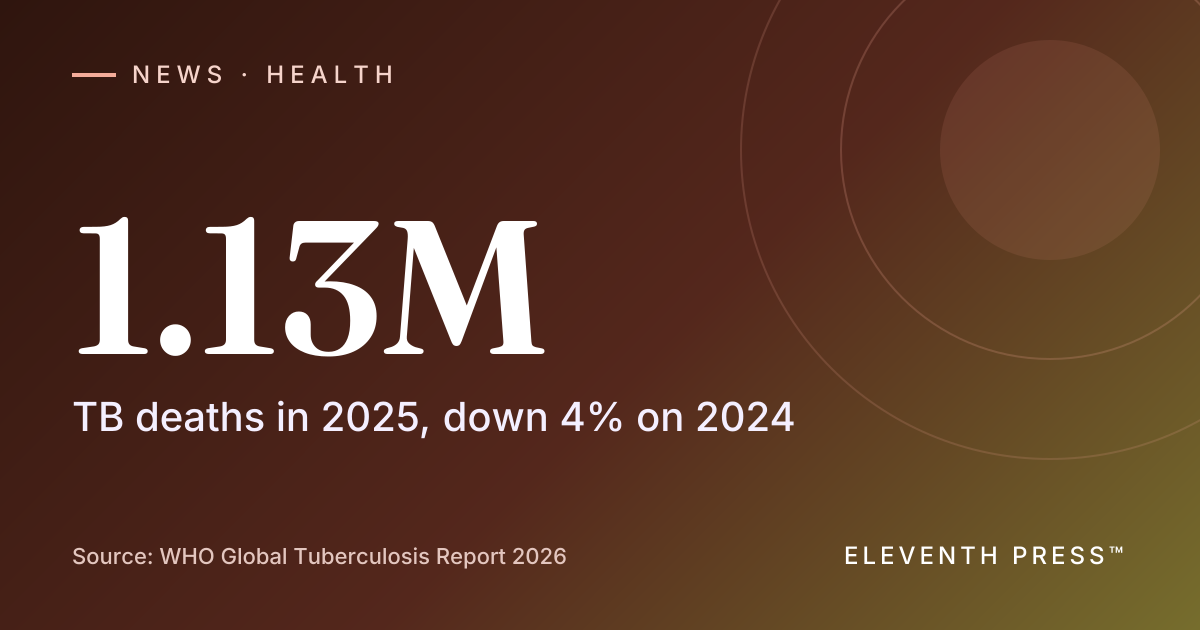
The World Health Organization’s Global Tuberculosis Report 2026, released on 12 November 2026, estimates that 10.6 million people fell ill with tuberculosis in 2025 and 1.13 million died[1,3]. Deaths fell 4% from 2024 and are now 35% below 2015 levels, but new cases fell by only 0.7% and an estimated 2.2 million people with TB were never diagnosed or reported[3].
Key facts
- 1An estimated 10.6 million people (95% uncertainty interval 9.8–11.4 million) developed TB in 2025, a 0.7% reduction on 2024[3].
- 2TB deaths fell 4%, from 1.18 million in 2024 to an estimated 1.13 million in 2025[3].
- 3Deaths are 35% lower than in 2015, which means the first milestone of WHO’s End TB Strategy has been reached, five years late[3].
- 4Of the 10.6 million people who developed TB, 8.4 million were diagnosed, leaving about 2.2 million undiagnosed or unreported[3].
- 5Domestic TB funding in low- and middle-income countries rose 14% to US$ 5.6 billion, partly offsetting a 14% fall in international donor funding[1,3].
- 6Total funding of US$ 6.6 billion in 2025 is about 30% of the US$ 22 billion a year that countries committed to reach by 2027[3].
How many people did tuberculosis kill in 2025?
WHO estimates that 1.13 million people died from TB in 2025 (95% uncertainty interval 1.05–1.22 million), down from 1.18 million in 2024[3]. That is a 4% fall in a single year and a 35% fall since 2015, the baseline year of the End TB Strategy[3].
Even so, tuberculosis remains the world’s leading cause of death from a single infectious agent[3,5]. WHO Director-General Tedros Adhanom Ghebreyesus noted that more than a million people still die every year from a disease that is preventable and treatable[1].
Are fewer people getting TB?
Only slightly. The report estimates 10.6 million new cases in 2025, about 75,000 (0.7%) fewer than in 2024, and the second consecutive year of a small decline[3]. TB Alliance, a non-profit drug developer, described the 1.6% fall in the global incidence rate as far too slow to meet international commitments[4].
This edition also changes how incidence is estimated: for the first time WHO used vital registration data in a new method for estimating TB incidence, which its technical appendix describes in detail[6]. Comparisons with older editions should use the revised time series in the 2026 report rather than headline figures published in earlier years.
Where is the diagnosis gap?
Of the estimated 10.6 million people who developed TB in 2025, 8.4 million were diagnosed and notified[3]. The remaining 2.2 million were either never diagnosed or diagnosed without being reported to national programmes[3]. Each undiagnosed case matters twice: the person misses treatment, and untreated pulmonary TB can keep spreading.
Who is paying for the TB response?
Countries themselves, increasingly. Domestic funding for TB prevention, diagnosis and treatment rose 14% to US$ 5.6 billion between 2024 and 2025, and domestic sources supplied 86% of the money available in 2025[1,3]. International donor funding moved the other way, falling 14% to US$ 0.94 billion[3].
The total, US$ 6.6 billion, is roughly 30% of the global target of US$ 22 billion per year by 2027[3]. Research funding lags further behind: US$ 1.2 billion in 2023, less than a quarter of the US$ 5 billion annual target[3].
Why it matters
The 2026 report shows a response that is still moving in the right direction but at a pace that leaves the 2030 targets out of reach. Falling deaths show that diagnosis and treatment work when people can reach them; the flat incidence curve and the 2.2 million missing cases show how many still cannot. For researchers and funders, the report’s financing chapter is a reminder that domestic budgets are now carrying most of the load.
Frequently asked questions
How many people died of tuberculosis in 2025?
WHO estimates 1.13 million TB deaths in 2025, with a 95% uncertainty interval of 1.05–1.22 million. That is 4% fewer than the 1.18 million estimated for 2024[3].
When was the Global Tuberculosis Report 2026 published?
WHO released the Global Tuberculosis Report 2026 on 12 November 2026[1,2].
Is tuberculosis still the deadliest infectious disease?
Yes. WHO describes TB as the leading cause of death worldwide from a single infectious agent[3,5].
How much funding does the TB response have?
Funding for TB prevention, diagnosis and treatment reached US$ 6.6 billion in 2025, about 30% of the US$ 22 billion per year targeted for 2027. Domestic sources provided 86% of it[3].
Sources & references
- 1.World Health Organization. (2026, November 12). Amid challenges, countries increase domestic investment to protect progress against tuberculosis [News release]. www.who.int/news/item/12-11-2026-amid-challenges-countries-increase-domestic-investment-to-protect-progress-against-tuberculosis
- 2.World Health Organization. (2026). Global tuberculosis report 2026. WHO. www.who.int/publications/i/item/9789240126480
- 3.World Health Organization. (2026). Global tuberculosis report 2026: Top findings and messages. WHO. cdn.who.int/media/docs/default-source/hq-tuberculosis/top-findings-and-messages_english.pdf
- 4.TB Alliance. (2026). New WHO report highlights promise of TB innovation and urgent need to accelerate progress. www.tballiance.org/new-who-report-highlights-promise-of-tb-innovation-and-urgent-need-to-accelerate-progress/
- 5.World Health Organization. (n.d.). Tuberculosis [Fact sheet]. www.who.int/news-room/fact-sheets/detail/tuberculosis
- 6.World Health Organization. (2026). Technical appendix: Methods used by WHO to estimate the global burden of TB disease. Global tuberculosis report 2026. cdn.who.int/media/docs/default-source/hq-tuberculosis/technical-appendix-global-tuberculosis-report-2026.pdf
Editorial standards: every figure in this story is taken from the source cited beside it, primary sources first. Spotted an error? Write to editorial@eleventhpress.com and we will correct it.
More from Media
News · Business & Economy
IMF October 2026 Outlook: Global Growth Slows to 3.1% as an AI Boom Offsets an Energy Shock
News · Neuroscience & Psychology
2026 Nobel Prize in Medicine Honours Optogenetics, the Light Switch for Brain Cells
News · Technology
Stanford AI Index 2026: Capabilities Surge, Adoption Reaches 53%, and Safety Lags Behind