News · Business & Economy
IMF October 2026 Outlook: Global Growth Slows to 3.1% as an AI Boom Offsets an Energy Shock
The IMF’s latest World Economic Outlook, “Resilience Under Strain, Urgent Choices”, sees growth of 3.1% this year and 3.4% in 2027, with inflation peaking at 4.7%.
By the Newsroom 3 min read4 sources
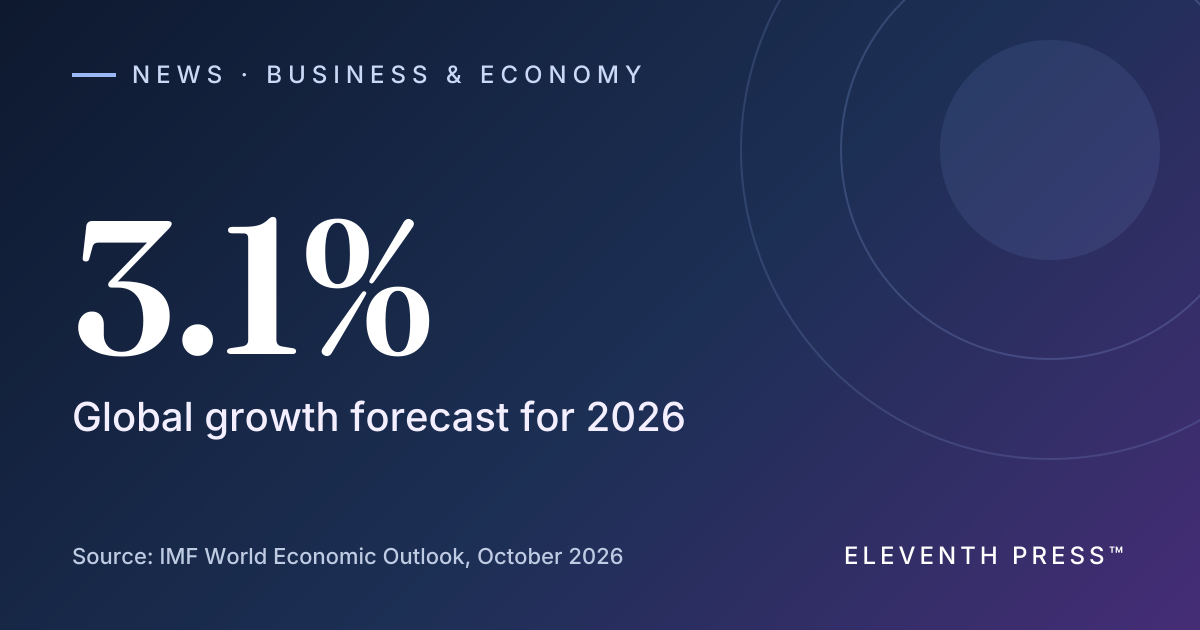
The International Monetary Fund projects global growth of 3.1% in 2026, 0.4 percentage points below 2025, rising to 3.4% in 2027, according to its October 2026 World Economic Outlook[1,2]. The IMF says higher energy and commodity prices triggered by war in the Middle East are acting as a negative supply shock, while an AI-driven technology boom is acting as a positive demand shock[2].
Key facts
- 1Global growth is projected at 3.1% in 2026, 40 basis points lower than in 2025, and 3.4% in 2027[2].
- 2Global headline inflation is projected to rise to 4.7% in 2026 before easing to 4.1% in 2027[2].
- 3The IMF names two opposing forces: an energy and commodity price shock from the war in the Middle East, and an AI-led technology boom[2].
- 4Country projections cited at the launch include 4.5% growth for China and 7% for India in 2026[2].
- 5The IMF judges that risks to the outlook are tilted to the downside[1].
What does the IMF forecast for global growth in 2026?
The October 2026 World Economic Outlook, subtitled “Resilience Under Strain, Urgent Choices”, was published on 13 October 2026 during the IMF and World Bank Annual Meetings[1]. It projects global activity to grow by 3.1% this year, 40 basis points lower than last year, and by 3.4% in 2027[2].
The forecast assumes that the conflict in the Middle East does not escalate further and that energy markets gradually normalise[1]. Growth is weakest in energy-importing and lower-income economies and strongest in countries closely tied to AI investment and supply chains[1,2].
Why is inflation rising again?
The IMF expects global headline inflation to rise notably to 4.7% in 2026 before easing to 4.1% in 2027[2]. The main driver is the increase in energy and other commodity prices triggered by the war, which the Fund describes as a negative global supply shock: it raises prices and lowers output at the same time[2].
How is artificial intelligence affecting the world economy?
On the other side of the ledger is the technology boom, which the IMF says is mostly driven by AI and acts as a positive demand shock through heavy investment in data centres, chips and power[2]. The Fund also flagged a structural risk: AI supply chains are highly concentrated in a few countries, sectors and firms, which creates potential chokepoints[2].
For businesses, that combination explains a split picture. Firms in AI-linked supply chains are investing and hiring, while energy-intensive and import-dependent sectors face higher costs.
What are the main risks?
The IMF judges that risks are tilted to the downside[1]. Its accompanying Fiscal Monitor briefing warned that debt service costs are rising, limiting governments’ room to respond to new shocks[3]. In a blog published alongside the report, IMF staff described global resilience as under strain and called for decisive policy action to rebuild fiscal buffers and keep inflation expectations anchored[4]. Escalation in the Middle East, a sharper correction in AI-related asset prices, or disruption at one of the concentrated points in AI supply chains would all push growth below the baseline[1,2].
Why it matters
A 3.1% world economy is not a recession, but it is one in which inflation is drifting up while growth drifts down. For entrepreneurs and finance teams, the IMF’s numbers argue for planning around higher input costs and tighter public budgets, while watching whether the AI investment cycle keeps its momentum.
Frequently asked questions
What is the IMF’s global growth forecast for 2026?
In the October 2026 World Economic Outlook, the IMF projects global growth of 3.1% in 2026 and 3.4% in 2027[1,2].
What inflation rate does the IMF expect in 2026?
The IMF projects global headline inflation of 4.7% in 2026, easing to 4.1% in 2027[2].
When was the October 2026 World Economic Outlook released?
It was released on 13 October 2026, during the IMF and World Bank Annual Meetings[1].
Sources & references
- 1.International Monetary Fund. (2026). World economic outlook, October 2026: Resilience under strain, urgent choices. IMF. www.imf.org/en/publications/weo/issues/2026/10/13/world-economic-outlook-october-2026
- 2.International Monetary Fund. (2026, October 13). Press briefing transcript: World economic outlook, Annual Meetings 2026. www.imf.org/en/news/articles/2026/10/13/tr-101326-press-briefing-transcript-world-economic-outlook-annual-meetings-2026
- 3.International Monetary Fund. (2026, October 14). Press briefing transcript: Fiscal monitor, Annual Meetings 2026. www.imf.org/en/news/articles/2026/10/14/tr-10142026-press-briefing-transcript-fiscal-monitor-annual-meetings-2026
- 4.International Monetary Fund. (2026, October 12). Global economic resilience is under strain, demanding decisive policy action [IMF Blog]. www.imf.org/en/blogs/articles/2026/10/12/global-economic-resilience-is-under-strain-demanding-decisive-policy-action
Editorial standards: every figure in this story is taken from the source cited beside it, primary sources first. Spotted an error? Write to editorial@eleventhpress.com and we will correct it.
More from Media
News · Health
WHO Global Tuberculosis Report 2026: Deaths Fall to 1.13 Million, but Progress Remains Too Slow
News · Neuroscience & Psychology
2026 Nobel Prize in Medicine Honours Optogenetics, the Light Switch for Brain Cells
News · Technology
Stanford AI Index 2026: Capabilities Surge, Adoption Reaches 53%, and Safety Lags Behind