News · Technology
Stanford AI Index 2026: Capabilities Surge, Adoption Reaches 53%, and Safety Lags Behind
The ninth AI Index finds frontier models matching human baselines on hard benchmarks while documented AI incidents rise and public trust trails expert optimism.
By the Newsroom 3 min read4 sources
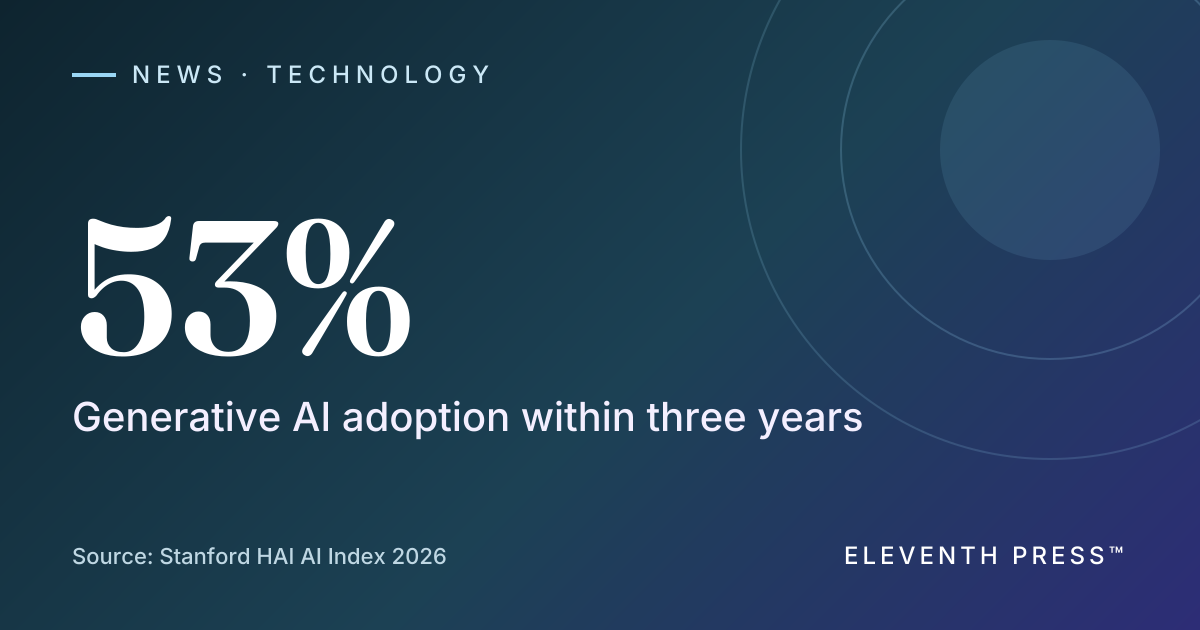
Stanford HAI’s 2026 AI Index reports that AI capability is still climbing fast: performance on the SWE-bench Verified coding benchmark rose from 60% to near 100% in a single year, and generative AI reached 53% population adoption within three years[1,2]. The same report finds documented AI incidents rising to 362, from 233 in 2024, and a wide gap between expert and public expectations[2].
Key facts
- 1Industry produced over 90% of notable frontier AI models in 2025[2].
- 2On SWE-bench Verified, a software-engineering benchmark, performance rose from 60% to near 100% in one year[2].
- 3As of March 2026, the top US model led the best Chinese model by only 2.7%[2].
- 4US private AI investment reached $285.9 billion in 2025[2].
- 5Generative AI reached 53% population adoption within three years; the United States ranks 24th at 28.3%[2].
- 6Documented AI incidents rose to 362, up from 233 in 2024[2].
How capable is AI in 2026?
Very capable, and unevenly so. The AI Index finds that several frontier models now meet or exceed human baselines on PhD-level science questions, multimodal reasoning and competition mathematics, and that SWE-bench Verified scores went from 60% to near 100% in a single year[2].
The report is just as clear about the gaps. The same class of models that can win a mathematics olympiad gold medal reads analogue clocks correctly only 50.6% of the time, against 90.1% for humans, and AI agents still fail roughly one in three attempts on structured benchmarks[2].
Who is building frontier AI?
Mostly companies. Industry produced more than 90% of notable frontier models in 2025[2]. The competitive gap between countries has narrowed sharply: as of March 2026, the leading US model was ahead of China’s best by just 2.7%[2]. The United States still dominates private investment, at $285.9 billion in 2025[3], but the inflow of AI researchers to the US has fallen 89% since 2017[2].
How fast are people and businesses adopting AI?
Generative AI reached 53% population adoption within three years, and the Index ranks the United States 24th, at 28.3%[2]. Business adoption is lower when measured strictly: the US Census Bureau’s Business Trends and Outlook Survey put the share of US firms using AI to produce goods or services at 19.8% in early May 2026, with much higher rates in the information (39.7%) and finance and insurance (33.9%) sectors[4].
Is AI safety keeping up?
Why it matters
For organisations deciding how to use AI, the Index offers a practical lesson: benchmark headlines describe what models can do at their best, not how reliably they perform on your task. The jagged profile, superhuman on some tests and unreliable on others, argues for careful evaluation, human review and clear accountability before AI output is trusted in high-stakes work.
Frequently asked questions
What is the Stanford AI Index?
An annual, independent report from the Stanford Institute for Human-Centered Artificial Intelligence (HAI) that tracks AI research, technical performance, investment, adoption and policy[1].
How many people use generative AI?
The 2026 AI Index reports that generative AI reached 53% population adoption within three years[2].
How much was invested in AI in 2025?
The AI Index reports US private AI investment of $285.9 billion in 2025[2].
Sources & references
- 1.Stanford Institute for Human-Centered Artificial Intelligence. (2026). The 2026 AI Index report. Stanford University. hai.stanford.edu/ai-index/2026-ai-index-report
- 2.Stanford HAI. (2026). Inside the AI Index: 12 takeaways from the 2026 report. hai.stanford.edu/news/inside-the-ai-index-12-takeaways-from-the-2026-report
- 3.Stanford HAI. (2026). AI Index report 2026, Chapter 4: Economy. hai.stanford.edu/ai-index/2026-ai-index-report/economy
- 4.U.S. Census Bureau. (2026, May). Large firms with at least 20 employees biggest AI users. www.census.gov/library/stories/2026/05/ai-use-businesses.html
Editorial standards: every figure in this story is taken from the source cited beside it, primary sources first. Spotted an error? Write to editorial@eleventhpress.com and we will correct it.
More from Media
News · Health
WHO Global Tuberculosis Report 2026: Deaths Fall to 1.13 Million, but Progress Remains Too Slow
News · Business & Economy
IMF October 2026 Outlook: Global Growth Slows to 3.1% as an AI Boom Offsets an Energy Shock
News · Neuroscience & Psychology
2026 Nobel Prize in Medicine Honours Optogenetics, the Light Switch for Brain Cells