News · Education
Education at a Glance 2026: OECD Finds Teacher Shortages Are About Qualifications, Not Just Vacancies
Unfilled posts are below 4% of the teaching workforce everywhere with data, but about 9% of teachers are not fully qualified, and 6.4% of qualified teachers left in a single year.
By the Newsroom 3 min read5 sources
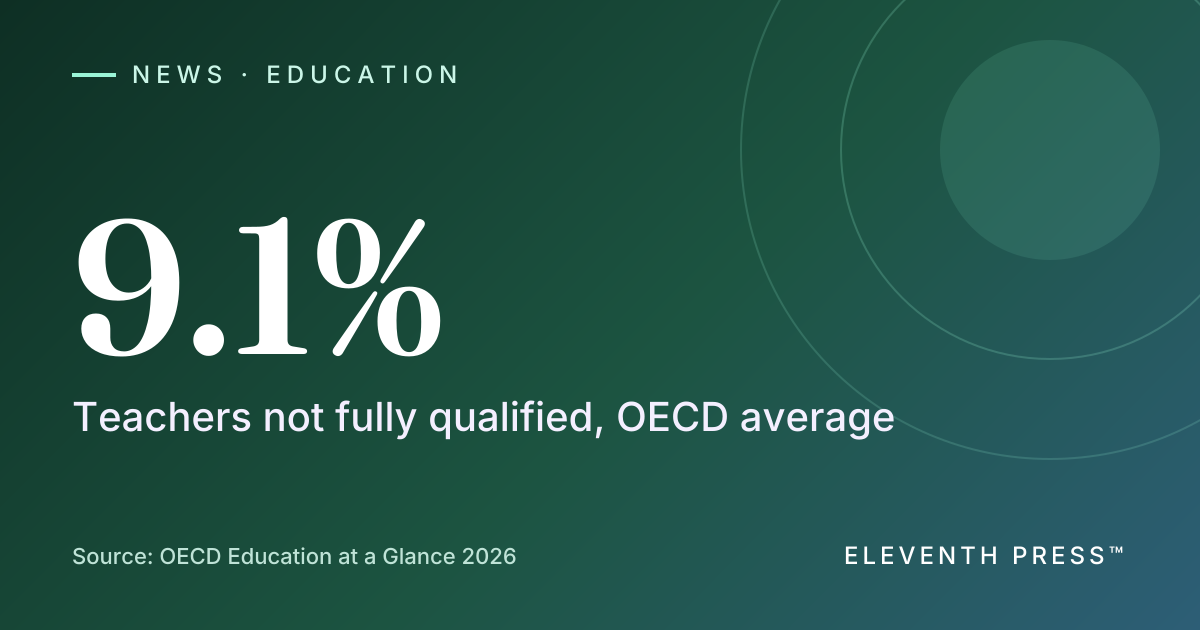
The OECD’s Education at a Glance 2026 finds that teacher shortages show up less as empty posts than as underqualified staff: unfilled vacancies were under 4% of the primary and secondary teaching workforce in all 20 systems with data in 2024/25, but 9.1% of teachers across OECD countries were not fully qualified[1,2]. Shortages are concentrated in mathematics and science and in rural, remote and disadvantaged schools[1].
Key facts
- 1In all 20 education systems with data, unfilled posts were under 4% of the primary and secondary teaching workforce in 2024/25[1].
- 2Across OECD countries, 9.1% of primary and secondary teachers were not fully qualified in 2024/25; the share exceeded 18% in Chile, Denmark, Estonia and Germany[1,2].
- 36.4% of fully qualified primary and secondary teachers left the profession during the 2024/25 school year[1].
- 411 of the 16 countries and economies with data reported shortages of fully qualified secondary mathematics and science teachers[1].
- 585% of teachers report being satisfied with their jobs, similar to other workers[1].
- 6The number of children aged 5–14 in OECD countries is projected to fall by 9% between 2024 and 2033[1].
What does Education at a Glance 2026 focus on?
How big is the teacher shortage?
It depends on how you measure it. Counting empty posts gives a reassuring answer: in every one of the 20 systems with data, unfilled positions were less than 4% of the combined primary and secondary teaching workforce in 2024/25[1].
Counting qualifications gives a different one. Across OECD countries, 9.1% of primary and secondary teachers were not fully qualified, meaning they did not yet meet all national requirements for a fully qualified teacher[2]. The share exceeded 18% in Chile, Denmark, Estonia and Germany, while Japan and Korea require teachers to be fully qualified before entering the profession[1]. Country notes show the spread: 13.9% in Sweden’s public schools against 0.3% in Ireland[4,5].
Where are teachers hardest to find?
In particular subjects and places. Among the 16 countries and economies with data, 11 reported shortages of fully qualified mathematics and science teachers at secondary level, and the OECD points to rural, remote and disadvantaged communities as the places where recruitment is most acute[1].
Why do teachers leave?
Attrition is meaningful: 6.4% of fully qualified primary and secondary teachers left the profession during the 2024/25 school year[1]. Job satisfaction is not the obvious culprit. The OECD reports that 85% of teachers are satisfied with their jobs, broadly in line with workers in other professions[1], which suggests that workload, working conditions and career structure deserve as much attention as pay.
Why it matters
Falling pupil numbers will ease pressure in some places, with the OECD projecting a 9% fall in the 5–14 population between 2024 and 2033, but the decline will be uneven[1]. The report’s central message for policymakers is that vacancy counts understate the problem. Students in shortage subjects and disadvantaged areas are the most likely to be taught by teachers who are not yet fully qualified.
Frequently asked questions
What percentage of teachers are not fully qualified in OECD countries?
Education at a Glance 2026 reports that 9.1% of primary and secondary teachers across OECD countries were not fully qualified in 2024/25[2].
Which subjects have the worst teacher shortages?
Mathematics and science: 11 of the 16 countries and economies with data reported shortages of fully qualified secondary teachers in those subjects[1].
How many teachers leave the profession each year?
6.4% of fully qualified primary and secondary teachers in OECD countries left the profession during the 2024/25 school year[1].
Sources & references
- 1.OECD. (2026, September). Teacher shortages are putting pressure on education systems across the OECD [Press release]. www.oecd.org/en/about/news/press-releases/2026/09/teacher-shortages-are-putting-pressure-on-education-systems-across-the-oecd.html
- 2.OECD. (2026). Teacher shortages and the attractiveness of the teaching profession. In Education at a glance 2026: OECD indicators. OECD Publishing. www.oecd.org/en/publications/2026/09/education-at-a-glance-2026_3bce4131/full-report/teacher-shortages-and-the-attractiveness-of-the-teaching-profession_074961e4.html
- 3.OECD. (2026). Education at a glance 2026: OECD indicators. OECD Publishing. www.oecd.org/en/publications/2026/09/education-at-a-glance-2026_3bce4131.html
- 4.OECD. (2026). Education at a glance 2026: Sweden [Country note]. www.oecd.org/en/publications/education-at-a-glance-2026_c0e523a9-en/sweden_f39a43ca-en.html
- 5.OECD. (2026). Education at a glance 2026: Ireland [Country note]. www.oecd.org/en/publications/education-at-a-glance-2026_c0e523a9-en/ireland_659909ab-en.html
Editorial standards: every figure in this story is taken from the source cited beside it, primary sources first. Spotted an error? Write to editorial@eleventhpress.com and we will correct it.
More from Media
News · Health
WHO Global Tuberculosis Report 2026: Deaths Fall to 1.13 Million, but Progress Remains Too Slow
News · Business & Economy
IMF October 2026 Outlook: Global Growth Slows to 3.1% as an AI Boom Offsets an Energy Shock
News · Neuroscience & Psychology
2026 Nobel Prize in Medicine Honours Optogenetics, the Light Switch for Brain Cells