News · Research
Nobel Prize in Physics 2026: Francis Halzen and the Neutrino Telescope Buried in Antarctic Ice
Halzen is honoured for decisive contributions to the IceCube Neutrino Observatory, a cubic kilometre of instrumented ice at the South Pole that discovered high-energy neutrinos from the cosmos.
By the Newsroom 2 min read8 sources
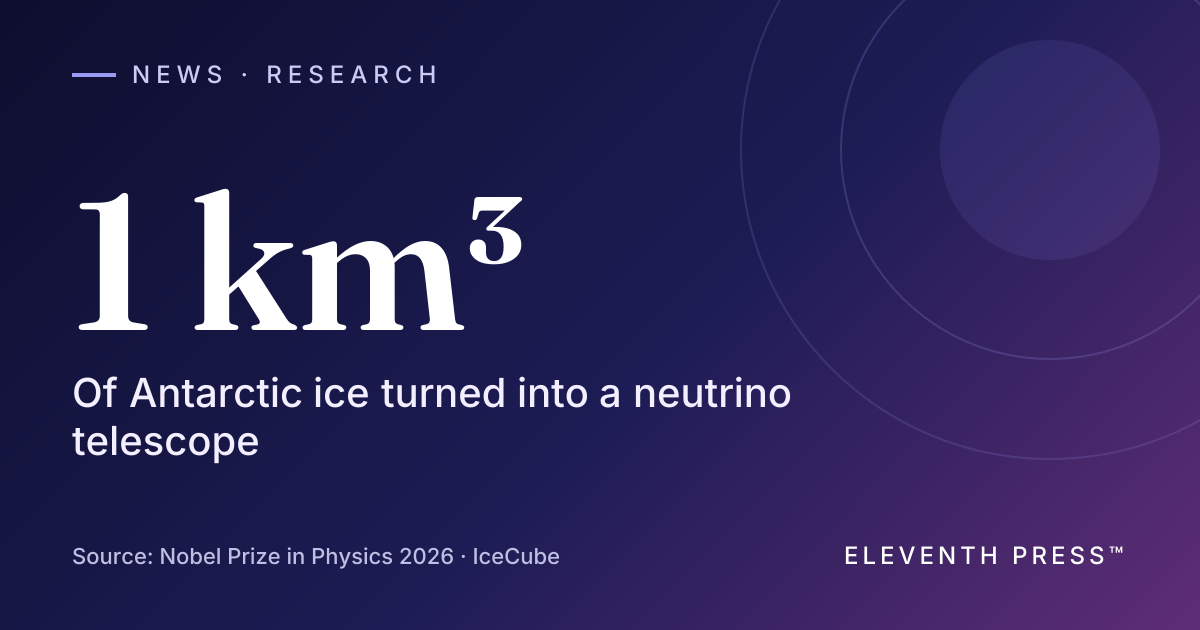
The Royal Swedish Academy of Sciences awarded the 2026 Nobel Prize in Physics to Francis Halzen “for decisive contributions to the IceCube Neutrino Observatory and the discovery of high-energy neutrinos of astrophysical origin”[1,3]. Halzen first proposed using Antarctic ice as a neutrino detector in 1988; the completed observatory instruments a full cubic kilometre of ice at the South Pole[3].
Key facts
- 1The prize was announced on 6 October 2026[1].
- 2Halzen, of the University of Wisconsin–Madison, is IceCube’s principal investigator[3,4].
- 3He first presented the idea of capturing neutrinos in South Pole ice in 1988[3].
- 4IceCube, completed in 2011, instruments a cubic kilometre of Antarctic ice[3].
- 5In 2013 IceCube reported the first evidence of high-energy neutrinos from beyond the solar system[5].
Why did Francis Halzen win the 2026 Nobel Prize in Physics?
Neutrinos are almost massless, carry no electric charge and pass through ordinary matter almost untouched, which makes them ideal messengers from violent cosmic events and extremely hard to catch[2]. Halzen championed the idea that a huge, transparent natural medium, the deep ice of Antarctica, could be turned into a detector large enough to register the rare high-energy neutrinos arriving from space[2,3].
How does IceCube detect neutrinos?
When a neutrino occasionally collides with an atom in the ice, it produces charged particles that emit a faint blue Cherenkov light. Thousands of optical sensors, lowered on cables into holes drilled deep into the ice, record that light; its timing and pattern reveal the neutrino’s energy and direction[2,3]. The finished detector, completed in 2011, spans an entire cubic kilometre[3].
What has IceCube discovered?
In 2013 the collaboration reported evidence of high-energy neutrinos of extraterrestrial origin, opening a new window on the universe[5]. In 2018 it linked a high-energy neutrino to a flaring blazar, TXS 0506+056, the first evidence of an individual cosmic source[6]. Later results identified neutrino emission from the active galaxy NGC 1068 in 2022[7] and from the plane of our own Milky Way in 2023[8].
Why it matters
IceCube helped found neutrino astronomy as a field and made it part of multimessenger astronomy, in which light, gravitational waves and particles are combined to study the same cosmic events. The prize also recognises a model of big science: a decades-long bet on an unconventional instrument, built and run by a large international collaboration.
Frequently asked questions
Who won the Nobel Prize in Physics 2026?
Francis Halzen, “for decisive contributions to the IceCube Neutrino Observatory and the discovery of high-energy neutrinos of astrophysical origin”[1].
What is the IceCube Neutrino Observatory?
A neutrino detector that instruments a cubic kilometre of ice at the South Pole with optical sensors, completed in 2011[3].
Sources & references
- 1.The Royal Swedish Academy of Sciences. (2026, October 6). Press release: The Nobel Prize in Physics 2026. NobelPrize.org. www.nobelprize.org/prizes/physics/2026/press-release/
- 2.The Royal Swedish Academy of Sciences. (2026). The Nobel Prize in Physics 2026: Popular science background. NobelPrize.org. www.nobelprize.org/uploads/2026/10/popular-physicsprize2026.pdf
- 3.IceCube Neutrino Observatory. (2026, October). Francis Halzen, IceCube principal investigator, wins 2026 Physics Nobel Prize. icecube.wisc.edu/news/awards/2026/10/francis-halzen-icecube-principal-investigator-wins-2026-physics-nobel-prize/
- 4.University of Wisconsin–Madison. (2026, October). University of Wisconsin–Madison professor Francis Halzen named 2026 Nobel laureate in physics. news.wisc.edu/university-of-wisconsin-madison-professor-francis-halzen-named-2026-nobel-laureate-in-physics/
- 5.IceCube Collaboration. (2013). Evidence for high-energy extraterrestrial neutrinos at the IceCube detector. Science, 342(6161), 1242856. doi.org/10.1126/science.1242856
- 6.IceCube Collaboration et al. (2018). Multimessenger observations of a flaring blazar coincident with high-energy neutrino IceCube-170922A. Science, 361(6398), eaat1378. doi.org/10.1126/science.aat1378
- 7.IceCube Collaboration. (2022). Evidence for neutrino emission from the nearby active galaxy NGC 1068. Science, 378(6619), 538–543. doi.org/10.1126/science.abg3395
- 8.IceCube Collaboration. (2023). Observation of high-energy neutrinos from the Galactic plane. Science, 380(6652), 1338–1343. doi.org/10.1126/science.adc9818
Editorial standards: every figure in this story is taken from the source cited beside it, primary sources first. Spotted an error? Write to editorial@eleventhpress.com and we will correct it.
More from Media
News · Health
WHO Global Tuberculosis Report 2026: Deaths Fall to 1.13 Million, but Progress Remains Too Slow
News · Business & Economy
IMF October 2026 Outlook: Global Growth Slows to 3.1% as an AI Boom Offsets an Energy Shock
News · Neuroscience & Psychology
2026 Nobel Prize in Medicine Honours Optogenetics, the Light Switch for Brain Cells