News · Research
Nobel Prize in Chemistry 2026: Kagan and Soai Explain How Molecules Choose a Hand
Henri B. Kagan and Kenso Soai are honoured for discovering non-linear effects and autocatalysis in asymmetric synthesis, work that bears on why life uses only one mirror-image form of its molecules.
By the Newsroom 2 min read6 sources
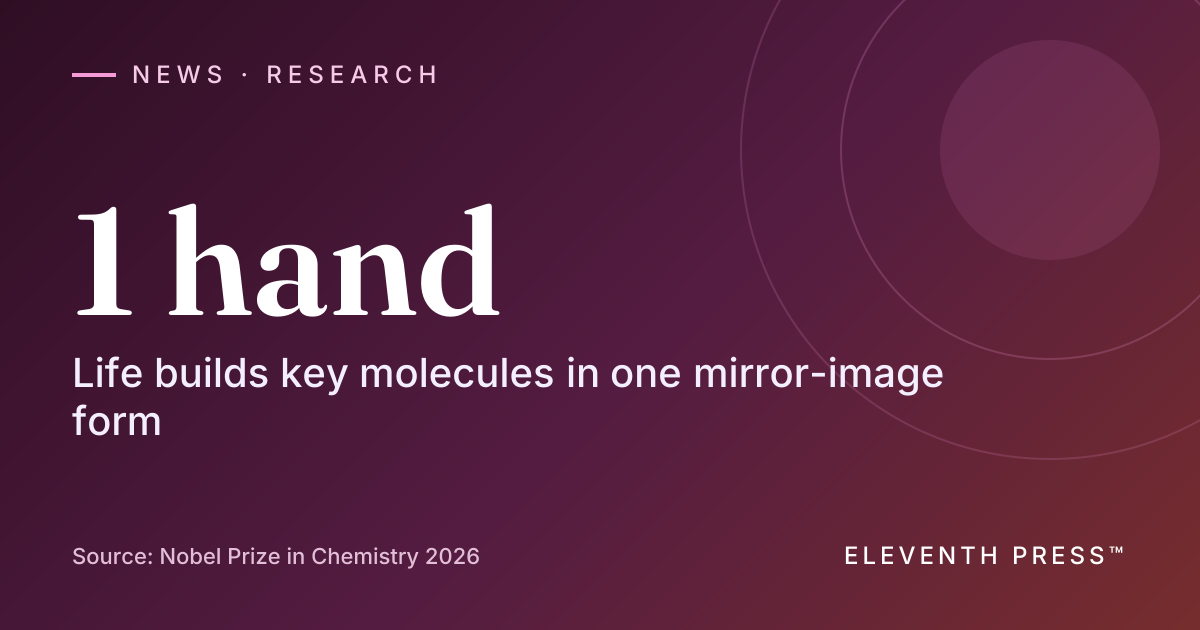
The 2026 Nobel Prize in Chemistry was awarded on 7 October 2026 to Henri B. Kagan and Kenso Soai “for the discovery of non-linear effects and autocatalysis in asymmetric organic synthesis”[1,2]. Their discoveries show how a small imbalance between mirror-image molecules can be amplified into an almost pure single form, a central clue to why living things use only one “hand” of key molecules[3].
Key facts
- 1The Royal Swedish Academy of Sciences announced the prize on 7 October 2026[1].
- 2Kagan is affiliated with Université Paris-Sud, France, and Soai with Tokyo University of Science, Japan[1,2].
- 3Kagan’s group described non-linear effects in asymmetric synthesis in 1986[3,5].
- 4Soai reported in 1995 a reaction whose product catalyses its own formation and amplifies a small excess of one mirror image[3,6].
- 5The laureates share 12 million Swedish kronor equally[2,4].
What is chirality, and why does it matter?
Many molecules come in two forms that are mirror images of each other, like left and right hands. This property is called chirality. The two forms have the same atoms and bonds but can behave very differently in living systems, which is why many medicines are made as a single mirror-image form. Life itself is lopsided: the amino acids in proteins and the sugars in DNA occur almost exclusively in one form, a property called homochirality[3].
What did Kagan discover?
Chemists had long assumed that the purity of a product made with a chiral catalyst would track the purity of the catalyst in a straight line. In 1986 Kagan and colleagues showed that this is not always true: in some reactions, a catalyst that is only partly pure produces a product that is purer, or less pure, than the simple proportion predicts[3,5]. These non-linear effects showed that chiral molecules interact with each other during a reaction in ways that can amplify an imbalance.
What did Soai discover?
Soai took the idea a decisive step further. In 1995 he reported an asymmetric autocatalytic reaction: the product is itself the catalyst for making more of the product, so a tiny initial excess of one mirror image grows with each cycle into an overwhelming majority[3,6]. The Nobel committee describes it as the first chemical reaction of its kind[3].
Why it matters
The Soai reaction is a working chemical model of how a slight, perhaps random, chiral bias on the early Earth could have been amplified into the single-handed chemistry of life. In applied chemistry, non-linear effects are now a standard tool for understanding how chiral catalysts behave, which matters for the efficient manufacture of single-form drugs and fine chemicals.
Frequently asked questions
Who won the 2026 Nobel Prize in Chemistry?
Henri B. Kagan and Kenso Soai, “for the discovery of non-linear effects and autocatalysis in asymmetric organic synthesis”[1,2].
What is asymmetric autocatalysis?
A reaction in which a chiral product catalyses its own formation, so a small excess of one mirror-image form is amplified with each cycle[3,6].
What is homochirality?
The fact that key molecules of life, such as amino acids and sugars, occur in only one of their two mirror-image forms[3].
Sources & references
- 1.The Royal Swedish Academy of Sciences. (2026, October 7). Press release: The Nobel Prize in Chemistry 2026. NobelPrize.org. www.nobelprize.org/prizes/chemistry/2026/press-release/
- 2.NobelPrize.org. (2026). The Nobel Prize in Chemistry 2026: Summary. www.nobelprize.org/prizes/chemistry/2026/summary/
- 3.NobelPrize.org. (2026). The Nobel Prize in Chemistry 2026: Popular information. www.nobelprize.org/prizes/chemistry/2026/popular-information/
- 4.Al Jazeera. (2026, October 7). Henri Kagan, Kenso Soai win Nobel chemistry prize for ‘mirror image’ work. www.aljazeera.com/news/2026/10/7/henri-kagan-kenso-soai-win-chemistry-nobel-for-mirror-image-breakthrough
- 5.Puchot, C., Samuel, O., Duñach, E., Zhao, S., Agami, C., & Kagan, H. B. (1986). Nonlinear effects in asymmetric synthesis: Examples in asymmetric oxidations and aldolization reactions. Journal of the American Chemical Society, 108(9), 2353–2357. doi.org/10.1021/ja00269a036
- 6.Soai, K., Shibata, T., Morioka, H., & Choji, K. (1995). Asymmetric autocatalysis and amplification of enantiomeric excess of a chiral molecule. Nature, 378(6559), 767–768. doi.org/10.1038/378767a0
Editorial standards: every figure in this story is taken from the source cited beside it, primary sources first. Spotted an error? Write to editorial@eleventhpress.com and we will correct it.
More from Media
News · Health
WHO Global Tuberculosis Report 2026: Deaths Fall to 1.13 Million, but Progress Remains Too Slow
News · Business & Economy
IMF October 2026 Outlook: Global Growth Slows to 3.1% as an AI Boom Offsets an Energy Shock
News · Neuroscience & Psychology
2026 Nobel Prize in Medicine Honours Optogenetics, the Light Switch for Brain Cells