News · Health & Fitness
One in Three Adults Still Miss WHO Exercise Targets After Two Decades, Nature Studies Find
Papers in Nature Health and Nature Medicine show that physical inactivity has barely moved since the early 2000s, despite a wave of national activity policies.
By the Newsroom 2 min read7 sources
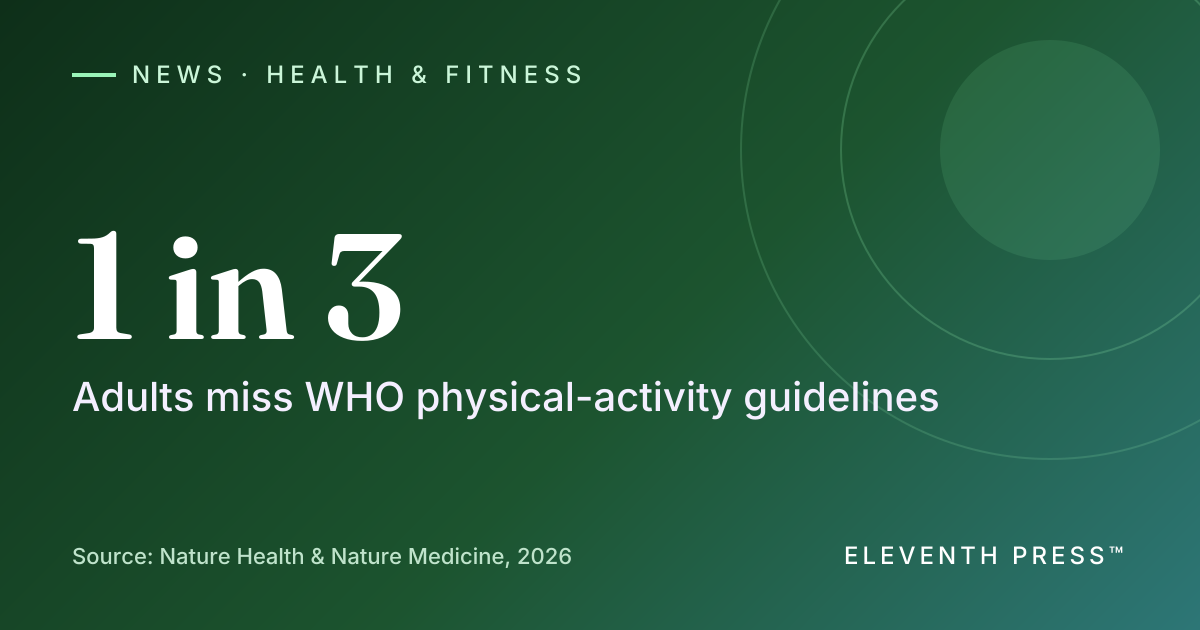
Global physical activity has not improved in two decades: about one in three adults and roughly 80% of adolescents worldwide still do not meet WHO activity guidelines, according to papers published in Nature Health and Nature Medicine in March 2026[1,2]. Countries adopted far more physical-activity policies after 2004, the authors found, but implementation has remained weak[2].
Key facts
- 1Three papers in Nature Health and Nature Medicine were published together in March 2026[1].
- 2About one in three adults and around 80% of adolescents do not meet WHO physical-activity guidelines[1,2].
- 3The prevalence of physical inactivity has stayed unchanged in most countries for two decades[2].
- 4More than 5 million deaths a year are attributed to physical inactivity[3].
- 5WHO’s goal of a 15% relative reduction in inactivity by 2030 is unlikely to be met[4].
How many people don’t get enough exercise?
WHO recommends that adults do at least 150–300 minutes of moderate-intensity aerobic activity a week, or 75–150 minutes of vigorous activity, plus muscle-strengthening on two or more days[7]. By that standard, about a third of adults and roughly four in five adolescents fall short[1,2].
The new papers build on WHO-led estimates published in 2024, which found that 31% of adults, nearly 1.8 billion people, were insufficiently active in 2022, up from 23% in 2000 and 26% in 2010[5,6].
Have physical-activity policies worked?
Policies have multiplied; behaviour has not followed. The Nature Health analysis by Ramírez Varela, Bauman, Woods and colleagues found that national adoption of physical-activity policies has increased since 2004, while the prevalence of inactivity remained unchanged in most countries[2]. The authors attribute the gap to weak implementation and low political priority[2]. An accompanying commentary concludes that WHO’s target of a 15% relative reduction in physical inactivity by 2030 is unlikely to be met[4].
Who is most affected?
The Nature Medicine paper looks at inequalities by gender and socioeconomic position across leisure-time, transport and occupational activity, using WHO STEPwise survey data[3]. It highlights that many people are active out of necessity, through manual work or walking for transport, rather than choice, and describes groups who remain “physical activity insecure” despite high overall activity[3]. It links physical inactivity to more than 5 million deaths each year[3].
Why it matters
The findings shift the conversation from individual motivation to systems: safe streets, active transport, school sport and workplace design. For individuals, the evidence remains encouraging; every extra bout of movement counts towards the guideline, and the largest health gains come from moving from very little activity to some.
Frequently asked questions
What share of adults don’t meet exercise guidelines?
About one in three adults worldwide do not meet WHO physical-activity guidelines; the 2024 WHO-led estimate was 31% of adults in 2022[2,5].
How much exercise does WHO recommend?
For adults, 150–300 minutes of moderate or 75–150 minutes of vigorous aerobic activity a week, plus muscle-strengthening activities on two or more days[7].
Has global physical activity improved?
No. The 2026 Nature Health analysis found inactivity prevalence unchanged in most countries over the last two decades[2].
Sources & references
- 1.Springer Nature. (2026, March). Health: Global physical activity levels have not improved over 20 years (Nature Medicine, Nature Health) [Press release]. Nature Asia. www.natureasia.com/en/info/press-releases/detail/9261
- 2.Ramírez Varela, A., Bauman, A., Woods, C., et al. (2026). Low global physical activity despite two decades of policy progress. Nature Health. www.nature.com/articles/s44360-025-00044-3
- 3.Physical activity for public health in the 21st century. (2026). Nature Medicine. doi.org/10.1038/s41591-026-04237-5
- 4.Physical activity remains under-prioritized in political agendas. (2026). Nature Health. www.nature.com/articles/s44360-026-00078-1
- 5.Strain, T., Flaxman, S., Guthold, R., et al. (2024). National, regional, and global trends in insufficient physical activity among adults from 2000 to 2022. The Lancet Global Health, 12(8), e1232–e1243. doi.org/10.1016/S2214-109X(24)00150-5
- 6.World Health Organization. (2024, June 26). Nearly 1.8 billion adults at risk of disease from not doing enough physical activity [News release]. www.who.int/news/item/26-06-2024-nearly-1.8-billion-adults-at-risk-of-disease-from-not-doing-enough-physical-activity
- 7.Bull, F. C., Al-Ansari, S. S., Biddle, S., et al. (2020). World Health Organization 2020 guidelines on physical activity and sedentary behaviour. British Journal of Sports Medicine, 54(24), 1451–1462. doi.org/10.1136/bjsports-2020-102955
Editorial standards: every figure in this story is taken from the source cited beside it, primary sources first. Spotted an error? Write to editorial@eleventhpress.com and we will correct it.
More from Media
News · Health
WHO Global Tuberculosis Report 2026: Deaths Fall to 1.13 Million, but Progress Remains Too Slow
News · Business & Economy
IMF October 2026 Outlook: Global Growth Slows to 3.1% as an AI Boom Offsets an Energy Shock
News · Neuroscience & Psychology
2026 Nobel Prize in Medicine Honours Optogenetics, the Light Switch for Brain Cells