News · Business & Entrepreneurship
Startups Hit Record Highs but Struggle to Survive, Global Entrepreneurship Monitor Warns
GEM’s 2025/2026 Global Report finds early-stage entrepreneurship at record levels across many of its 53 economies, but too few ventures grow into established businesses.
By the Newsroom 3 min read3 sources
The Global Entrepreneurship Monitor’s 2025/2026 Global Report, “From Uncertainty to Opportunity”, finds early-stage entrepreneurial activity at record highs in many of the 53 economies it surveys, while the progression from startup to established business, a firm older than 3.5 years, is stalling[1]. GEM calls this the “Survival Gap”[1].
Key facts
- 1The report covers 53 economies and finds record levels of early-stage entrepreneurial activity in many of them[1].
- 2Too few new ventures reach established-business status, creating what GEM calls a “Survival Gap”[1].
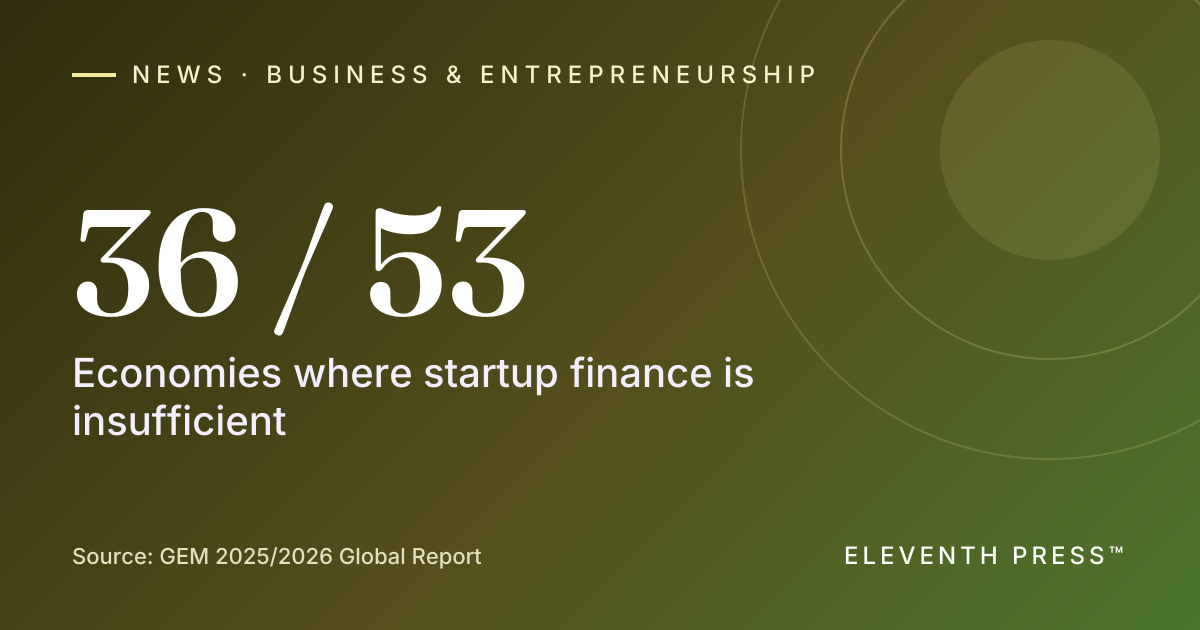
- 3Entrepreneurial finance is rated insufficient in 36 of the 53 economies[1].
- 4Fear of failure deters roughly two in five adults from starting a business[1].
- 5GEM’s companion women’s report finds women lead about 40% of high-potential new businesses, but their activity drops sharply at the established stage[2,3].
What is the entrepreneurship “Survival Gap”?
GEM tracks Total early-stage Entrepreneurial Activity (TEA): the share of adults starting or running a new business. The 2025/2026 report finds that TEA has reached record highs, but that progression to established business, meaning a firm that has paid wages for more than 3.5 years, is stalling across many economies[1]. In other words, more people are starting businesses than ever, and too few of those businesses last.
What holds new businesses back?
GEM’s experts rated both the provision of and access to entrepreneurial finance as insufficient in 36 of the 53 economies, and entrepreneurship education at school was the lowest-rated condition in 33 of them[1]. Fear of failure deters roughly two in five adults, although people who have previously exited a business are more likely to start again[1].
Only India, Lithuania, Saudi Arabia and the United Arab Emirates were rated sufficient on all 13 of GEM’s framework conditions, and the UAE ranked first on the National Entrepreneurship Context Index for the fifth year in a row[1].
Are entrepreneurs ready for artificial intelligence?
Not everywhere. In 19 of 48 economies, fewer than one in three new entrepreneurs expect AI to become very important to their business in the near term, a pattern GEM warns could produce a two-tier entrepreneurial economy[1]. On motivation, an average of 84% of early-stage entrepreneurs say they consider social or environmental impact in their business decisions[1].
What does GEM find about women entrepreneurs?
GEM’s Women’s Entrepreneurship Report, based on its 2025 Adult Population Survey of 150,799 adults in 48 economies, finds that 12% of women surveyed were running new businesses, compared with 14% of men, and that women lead about 40% of high-potential new businesses[2,3]. Women also made up 44% of entrepreneurs emphasising digitalisation and 43% of those reporting AI innovation[2].
The drop-off comes later: women’s high-potential activity was 6.0% at the early stage but 0.1% at the established-business stage, and the women-to-men ratio in established business ownership, 0.69, was the widest gap across the life cycle[2]. Women were also more likely than men to cite family or personal reasons for exiting a business (20% vs 13%)[2].
Why it matters
Startup counts make attractive headlines, but jobs, innovation and tax revenue come disproportionately from firms that survive and grow. GEM’s data point policymakers and support programmes towards the second and third years of a business: access to growth finance, management skills, and support for founders with caring responsibilities.
Frequently asked questions
What is the Global Entrepreneurship Monitor?
GEM is an international research consortium that surveys adults and national experts each year to measure entrepreneurial activity and the conditions that support it; the 2025/2026 Global Report covers 53 economies[1].
What does TEA mean in the GEM report?
Total early-stage Entrepreneurial Activity: the share of adults who are starting or running a new business[1].
What share of high-potential startups are led by women?
GEM’s women’s entrepreneurship report finds that women lead about 40% of high-potential new businesses globally[3].
Sources & references
- 1.Global Entrepreneurship Monitor. (2026). GEM 2025/2026 global report: From uncertainty to opportunity. GERA. www.gemconsortium.org/reports/latest-global-report
- 2.Global Entrepreneurship Monitor. (2026). GEM 2025/2026 women’s entrepreneurship report: How metrics shape the narrative. GERA. www.gemconsortium.org/reports/womens-entrepreneurship
- 3.Global Entrepreneurship Monitor. (2026). New GEM report finds women are active in high-potential entrepreneurship — but activity falls sharply at the established business stage [News release]. gemconsortium.org/news/new-gem-report-finds-women-are-active-in-high-potential-entrepreneurship-%E2%80%94-but-activity-falls-sharply-at-the-established-business-stage
Editorial standards: every figure in this story is taken from the source cited beside it, primary sources first. Spotted an error? Write to editorial@eleventhpress.com and we will correct it.
More from Media
News · Health
WHO Global Tuberculosis Report 2026: Deaths Fall to 1.13 Million, but Progress Remains Too Slow
News · Business & Economy
IMF October 2026 Outlook: Global Growth Slows to 3.1% as an AI Boom Offsets an Energy Shock
News · Neuroscience & Psychology
2026 Nobel Prize in Medicine Honours Optogenetics, the Light Switch for Brain Cells